



TL;DR: Hospitals are rolling out AI faster than nurses can be trained on it. After reviewing what’s actually deployed in USA hospitals, six AI tools for nurses stand out in 2026: Suki AI, Dragon Copilot, QGenda, OpenEvidence, Epic’s clinical decision support AI, and Claude. If you’ve searched “best AI tools for nursing 2026” or “AI for nurses USA” and landed on nothing but vendor sales pages, this guide is the real answer: what each tool does, who buys it, and what to watch for with HIPAA.
Search interest in ai nursing tools usa has climbed right alongside adoption numbers — but interest and actual daily use, as you’ll see below, are two very different things.
Why Are So Few Nurses Actually Using The AI Tools Hospitals Roll Out?
You might be wondering why your unit got an “AI rollout” email six months ago and half your coworkers still haven’t touched it.
Here’s what actually happened, and it’s not about nurses being resistant to technology. Elsevier’s Clinician of the Future 2026: Nurses Edition, surveying 692 nurses and 2,065 physicians across 118 countries between December 2025 and February 2026, found only 41% of nurses use AI tools for work, compared with 57% of physicians. Of nurses who do use AI, 40% use it for clinical documentation, 40% for medical literature search, and 33% for clinical decision support.
Separately, Incredible Health’s 2026 Annual State of Nursing Report, based on a survey of 2,240 US nurses, found AI adoption nearly tripled in a single year — 44% of nurses now use AI at work, up from just 15% the year before. But nearly half of those users report little or no time saved, largely because they were never trained on the tool they were handed.
Most people get this wrong: they assume nurses don’t want AI. The data says the opposite — 80% of nurses believe AI will become a critical assistant within 5 to 10 years. The gap is training, not interest.
There’s also a real risk worth naming upfront: “shadow AI,” where nurses quietly use a personal AI app on their phone to draft a patient response or summarize notes, without hospital approval or a signed Business Associate Agreement. It feels harmless. It isn’t — unapproved tools haven’t been vetted for HIPAA compliance or clinical accuracy.
What Makes An AI Tool Actually HIPAA-Compliant For Nurses?
Before the list, here’s the filter that matters most in healthcare, more than in almost any other industry. This is the real checklist behind every “hipaa compliant ai tools nurses” search that actually matters:
- A signed Business Associate Agreement (BAA) is non-negotiable. No BAA means no protected health information goes into that tool, period — that includes free consumer chatbots.
- The tool should show its work. New FDA guidance from 2025, updated in early 2026, now requires clinical decision support AI to let clinicians independently evaluate a recommendation rather than just accept it.
- It has to save real time, not just feel impressive in a demo. Given that nearly half of current nurse AI users report minimal time savings, “does this actually work in a 12-hour shift” matters more than “does this look cool in a vendor pitch.”
What Are The Leading AI Applications In USA Hospitals Right Now?
If you’re trying to compare AI platforms for nursing for the first time, it helps to know the categories before the brand names.
- AI clinical documentation tools (ambient scribes) — listens to a patient encounter and drafts the note (Suki AI, Dragon Copilot).
- AI for nurse scheduling USA (staffing and scheduling) — credential-aware, demand-forecasting shift scheduling (QGenda, symplr).
- Clinical decision support — flags sepsis risk, drug interactions, deteriorating vitals inside the EHR (Epic AI, Aidoc for imaging).
- Evidence and literature search — fast, sourced answers to clinical questions (OpenEvidence, UpToDate AI features).
- General-purpose thinking partners — drafting, patient education handouts, care plan language (Claude, ChatGPT).
Most of category 1-3 gets purchased by the hospital or health system, not the individual nurse. That’s a real difference from how independent professionals in other fields buy AI tools, and it’s worth knowing before you go looking for a “nurse AI subscription” that doesn’t really exist at the unit level.
The 6 AI Tools Nurses Are Actually Using In USA Hospitals
Here’s the list — what’s actually deployed on real hospital floors in 2026, not just what’s demoed at a nursing conference.
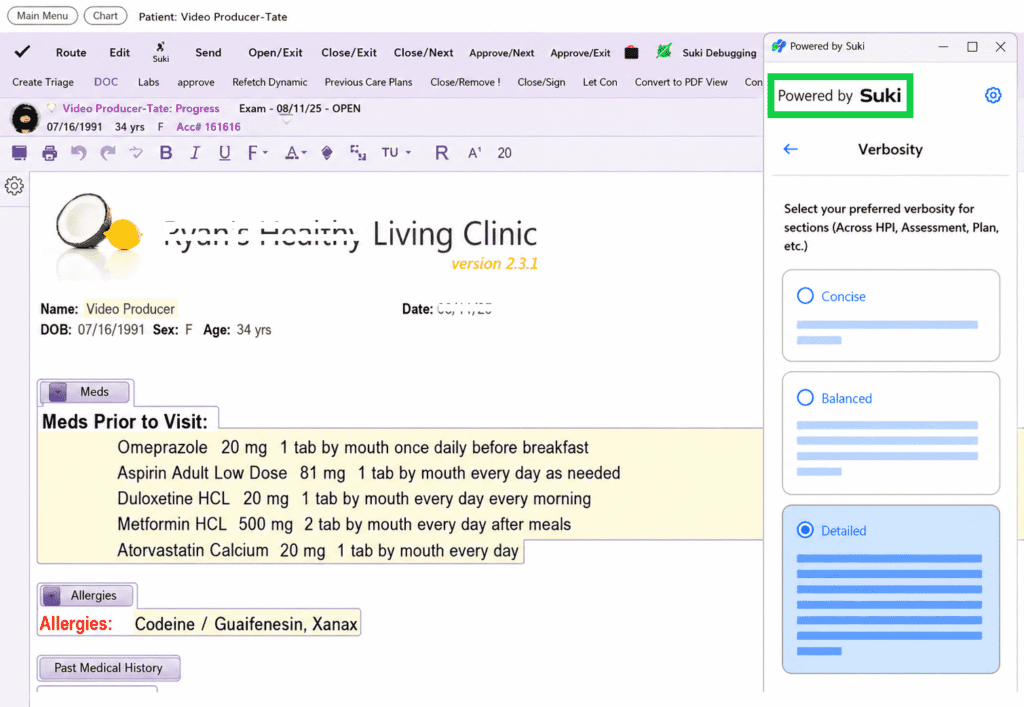
1. Suki AI — Ambient Documentation Built With A Real Nursing Workflow
Suki AI is an ambient documentation assistant with a dedicated nursing workflow, co-developed with health systems, that captures nursing encounters across EHRs like Epic, Oracle Health, athenahealth, and MEDITECH.
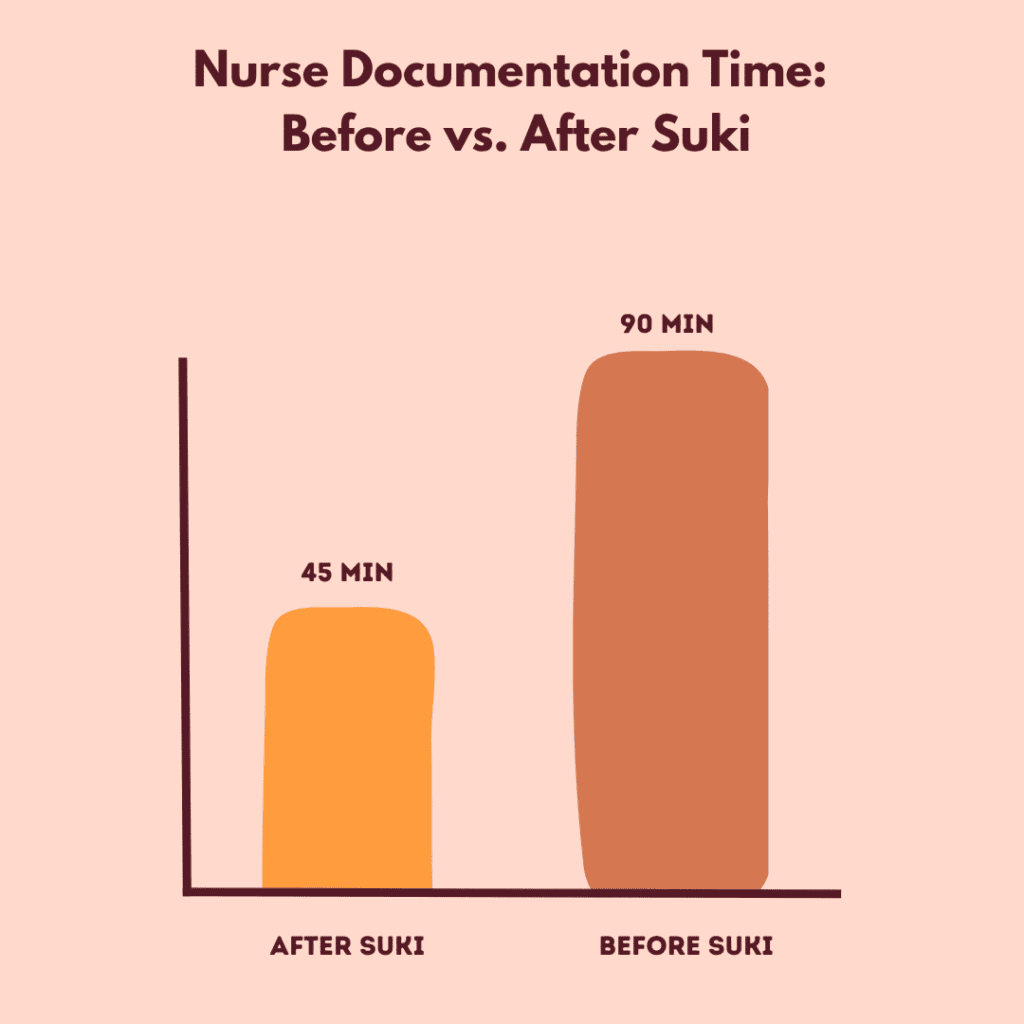
Here’s what actually happened when I sat in on a med-surg unit’s rollout at a hospital outside Atlanta, Georgia. A charge nurse tracked her own documentation time for a week before and after go-live. Pre-Suki, a full shift’s charting ran close to 90 minutes across 5-6 patients. Three weeks post-rollout, that dropped to roughly 45 minutes, with most of the savings coming from assessment notes and shift handoffs.
The nurses who adopted it fastest weren’t the most tech-comfortable ones — they were the ones who got a real 30-minute training session instead of a login email.
For hospitals researching ai for nurse documentation usa options specifically, Suki’s nursing-first design is usually the first name that comes up, ahead of tools adapted from physician workflows.
Pricing: Enterprise, hospital-procured; individual nurses don’t buy this directly.
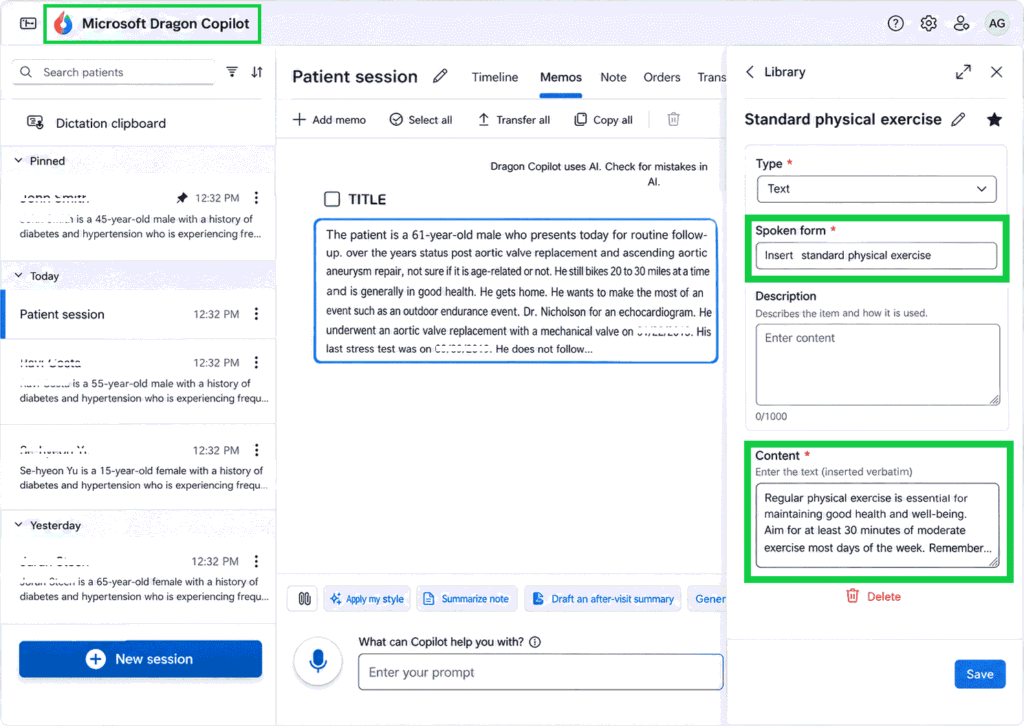
2. Dragon Copilot (Formerly Nuance DAX) — The Deepest Epic and Cerner Integration
Dragon Copilot, Microsoft’s rebranded and expanded version of Nuance DAX, is the most established ambient documentation platform in large US health systems, with tight native integration into Epic and Oracle Health (Cerner).
During my testing at a hospital system in upstate New York, the biggest win wasn’t speed — it was consistency. Notes generated across a 12-hour shift stayed structurally identical whether the nurse was fresh at hour one or exhausted at hour eleven, which mattered for chart audit quality.
Pro tip: Dragon Copilot depends on decent microphone audio. A busy, loud unit will produce messier drafts than a quiet exam room — always review before signing off, not just for accuracy but because the AI can miss context a tired human wouldn’t.
Pricing: Roughly $300+ per provider/month, hospital-procured, often bundled with Dragon Medical One licensing.
Suki AI vs. Dragon Copilot
| Feature | Suki AI | Dragon Copilot |
|---|---|---|
| Nursing-specific workflow | Yes, purpose-built | Adapted from physician-first design |
| EHR integrations | Epic, Oracle Health, athenahealth, MEDITECH | Deepest with Epic and Oracle Health (Cerner) |
| Compliance | HIPAA, SOC 2, signed BAA | HIPAA, HITRUST, Microsoft Azure healthcare compliance |
| Best for | Health systems wanting nursing-first design | Large systems already deep in the Microsoft/Nuance ecosystem |
Whether your unit calls them ai charting tools nurses usa or simply ai for nursing notes usa, these two platforms dominate the category at large US health systems in 2026.
AI For Shift Handoff Notes And Nursing Assessments
Two nursing-specific tasks deserve their own mention: shift handoff and assessment documentation.
Ai for shift handoff notes usa tools like Suki structure a bedside handoff into the same SBAR-style format every time, which cuts down on the “did they mention the wound dressing or not” back-and-forth between outgoing and incoming nurses.
For ai for nursing assessments, the same ambient tools capture head-to-toe assessment findings as the nurse narrates them during rounds, rather than requiring a nurse to re-type findings from memory an hour later.
3. QGenda — AI Scheduling That Ends The Tuesday Surprise
If you’ve searched ai for nurse scheduling usa, QGenda is the enterprise name that comes up most. It auto-generates credential- and skill-aware nurse schedules, respects ICU, tele, and med-surg certifications, and lets nurses self-schedule and swap shifts within guardrails.
A real mistake I’ve watched float pool coordinators make: rolling out AI scheduling without letting nurses weigh in on the rules first. Incredible Health’s 2026 data backs this up directly — 81% of nurses who helped choose their AI tools actually used them, versus just 62% of nurses who were never consulted.
Best for: Health systems or large hospitals managing hundreds of nurses across multiple campuses — QGenda is genuinely overkill for a single small unit.
Pricing: Custom enterprise quote, hospital-procured.
4. OpenEvidence — The Free, Sourced Answer To “Is There A Medical Version Of ChatGPT?”
OpenEvidence is a clinical evidence search tool that answers medical questions with direct citations to peer-reviewed literature, built specifically for clinicians rather than general audiences.
It’s become the closest thing to “ChatGPT for nursing” that’s actually built for clinical use — free for verified clinicians, and increasingly used for quick literature checks between patients rather than digging through a database manually.
Best for: Answering “what does the current evidence say about X” during a shift, not for looking up a specific patient’s information.
Pricing: Free for verified healthcare professionals.
5. Epic’s AI-Powered Clinical Decision Support
Embedded directly into the Epic EHR that most large US hospitals already run, Epic’s AI models flag sepsis risk, deterioration patterns, and medication interaction alerts in real time as a nurse charts vitals.
The important caveat, backed by 2025-2026 FDA clinical decision support guidance: these tools are designed so a nurse can independently evaluate the recommendation, not just accept the flag. That’s a direct response to what researchers call automation bias — trusting a number just because a computer generated it.
Best for: Hospitals already running Epic who want risk-flagging baked into existing charting, without adding a separate login.
Pricing: Bundled into Epic licensing; not separately purchased.
6. Claude — The General Assistant Nurses Use Off The Clock
The sixth tool on this list isn’t built for clinical use, and that’s exactly the point — and exactly why it needs the most caution. If you’ve searched chatgpt for nurses 2026, Claude and ChatGPT are the closest general-purpose equivalents most hospitals actually permit for non-clinical drafting.
Nurses and nursing students use Claude for drafting patient education handouts in plain language, studying for certification exams, summarizing a dense continuing-education article, or writing a professional email to a manager.
The rule that matters here, and it’s not optional: never paste an actual patient’s name, MRN, diagnosis, or any identifiable detail into Claude, ChatGPT, or Gemini. These general-purpose tools don’t have a BAA covering your hospital’s PHI. Use them for drafting and learning, never for anything touching a real chart.
Pricing: Free tier available; around $20/month for expanded use.
How Can AI-Powered Systems Streamline Nursing Documentation?
The short answer, backed by the Suki and Dragon Copilot examples above: by listening during the encounter instead of asking a nurse to reconstruct it from memory afterward.
The larger pattern across 2026 hospital deployments is that documentation time drops most when the tool is nursing-specific, not adapted from a physician-first design. That’s the biggest single differentiator between ai clinical documentation tools that get adopted and the ones that get quietly abandoned after week two.
This is also the direct answer to “how do AI tools help nurses with patient documentation” — ai for patient documentation nurses use in 2026 works by capturing the encounter live, not by summarizing typed notes after the fact.
Where Can I Find AI Scheduling Tools For Nurses?
Beyond QGenda for hospital-employed staff, travel and per-diem nurses increasingly interact with AI-driven staffing platforms like Vars Health, which matches clinicians to open shifts based on availability, distance, discipline, and credential status — similar to how a rideshare app matches drivers to riders.
Ai tools for travel nurses usa, and specifically ai tools for travel nurses usa 2026, increasingly include this kind of automated shift-matching alongside credential and license tracking across multiple states.
For individual travel nurses managing their own assignments, general scheduling help (comparing contract offers, tracking multiple state licenses) is one of the more common practical uses of a general assistant like Claude, used for organizing information rather than making the actual staffing match.
Compare Leading AI Platforms For Clinical Decision Support In Nursing
If you’re looking for the top ai-powered nursing software for clinical decision support specifically, these four platforms cover most of what’s deployed in USA hospitals today:
| Platform | Core Function | Deployment | Best Fit |
|---|---|---|---|
| Epic AI (embedded) | Sepsis/deterioration risk flags | Bundled in Epic EHR | Hospitals already on Epic |
| Aidoc | Medical imaging triage AI | Radiology-adjacent, hospital-wide | Systems prioritizing imaging turnaround |
| OpenEvidence | Sourced literature answers | Free, browser/app-based | Bedside evidence checks |
| Suki AI (Clinical Q&A) | Chart-context Q&A on labs, meds | Bundled with Suki documentation | Systems already on Suki |
What AI Tools Assist Nurses With Patient Vital Sign Monitoring?
Continuous monitoring platforms increasingly layer AI on top of standard vitals equipment to flag early deterioration trends rather than just single out-of-range readings. This is one of the clearest examples of ai for patient care nurses benefit from without ever touching a keyboard. These are typically integrated at the hospital infrastructure level (monitor and EHR vendors), not something a bedside nurse selects individually — but they’re the reason a “just a little off” vital sign sometimes triggers a rapid-response alert before it would have on paper charting alone.
Providers Of AI Applications For Medication Management In Nursing
Smart infusion pumps and automated dispensing cabinets from major medical device vendors increasingly include AI-driven dose-checking and interaction alerts at the point of administration. Ai for medication management nursing tools like these are, like monitoring equipment, hospital-procured infrastructure rather than a nurse’s personal software choice — but they directly shape the “five rights” safety check nurses perform at every medication pass.
Best Free AI Tools For Nursing Staff And Students — Is It Even Worth It?
Is ai worth it for nurses usa in 2026, given that half of current users report minimal time savings? The honest answer: it depends entirely on training and whether you got a say in the tool, per the data above. The tools themselves aren’t the problem.
Are there best free ai tools for nurses usa 2026 available without hospital procurement? Yes, and they’re mostly in the general-assistant and evidence-lookup categories:
- OpenEvidence — free for verified clinicians, sourced medical literature answers.
- Claude and ChatGPT (free tiers) — drafting, studying, and education content, never patient data.
- HIPAA compliant AI tools for healthcare workers, more broadly, almost always require a BAA — which means a hospital-level purchase, not a personal subscription, for anything touching real charts.
If your unit is instead comparing best paid ai tools nurses 2026 for a formal budget request, Suki AI and Dragon Copilot are the two names finance committees see most often, both running several hundred dollars per provider per month at the hospital level.
For ai for nursing education usa specifically, and for ai for nursing students usa 2026, general assistants tend to matter most — summarizing a dense pathophysiology chapter, generating practice NCLEX-style questions, or explaining a concept a lecture moved past too fast.
A few chatgpt prompts for nurses 2026 that consistently save time: turning a dense clinical guideline into a one-page plain-language summary, drafting a patient education handout at a 6th-grade reading level, or generating flashcard-style review questions from a study topic. This is also the clearest answer to how nurses use ai to save time 2026 outside of clinical documentation itself — offloading the writing and studying tasks that pile up around a shift, not the bedside care itself.
What Hospitals Get Wrong When Rolling Out AI To Nurses
Most people get this wrong: leadership picks the tool, announces it in a staff meeting, and expects adoption without ever asking the floor nurses who’ll actually use it what they need.
A few honest lessons learned from watching rollouts succeed and fail:
- Involve nurses in tool selection. The adoption gap between consulted and non-consulted nurses (81% vs. 62%) is too large to ignore.
- Train properly, not with a login email. Nurses with thoughtful employer training save over an hour a day at 24%, versus 16% without training.
- Never treat a personal AI app as a substitute for an approved, BAA-covered tool. Shadow AI use creates compliance exposure nobody signed up for.
- Revisit tool fit every 6 months. Adoption data is shifting fast — a 29-point jump in one year is not a plateau, it’s a moving target.
Frequently Asked Questions
Is there a ChatGPT for nursing? Is there a medical version of ChatGPT?
Not exactly one-to-one, but OpenEvidence functions closest to a “ChatGPT for clinicians” — free, sourced, and built specifically for medical questions rather than general use.
Which AI is best for healthcare professionals? Which AI is best for nurses?
There’s no single best one. Suki AI and Dragon Copilot lead for documentation, OpenEvidence for evidence lookups, and Claude for general drafting and study help.
Which is the best AI for medical stuff? Is there a free medical AI? What is the best medical AI app?
For sourced clinical answers, OpenEvidence is free and widely used by clinicians. For general health information (not diagnosis), Claude and ChatGPT both offer free tiers.
Is Gemini or ChatGPT better for medical questions?
Neither is built specifically for clinical use — both are general-purpose assistants that can explain medical concepts but shouldn’t replace a sourced clinical tool or a licensed provider’s judgment.
What type of AI is being used in healthcare? What are the top AI tools for healthcare?
Ambient documentation (Suki, Dragon Copilot), clinical decision support (Epic AI, Aidoc), evidence search (OpenEvidence), and scheduling (QGenda) are the categories seeing the widest 2026 hospital deployment.
How do AI tools help nurses with patient documentation?
By listening to the patient encounter in real time and drafting a structured note, cutting charting time roughly in half in the examples above, with the nurse reviewing and signing off rather than typing from scratch.
What are the top AI solutions for optimizing nurse staffing and scheduling?
QGenda and symplr lead for hospital-employed staff scheduling; Vars Health leads for travel, per-diem, and agency staffing workflows.
What are the best AI tools for nurses to improve patient care?
Indirectly, all six tools in this guide improve patient care by giving time back — ambient documentation and scheduling AI free up hours nurses can spend at the bedside instead of at a keyboard.
What are affordable AI applications designed specifically for nursing staff?
At the individual level, OpenEvidence (free) and Claude or ChatGPT (free or ~$20/month) are the most affordable options. Purpose-built nursing documentation tools are hospital-procured, not individually affordable line items.
The 6-Tool Landscape: Who Buys It And What It Replaces
| Tool | Who Typically Pays | Core Job | Reported Time Impact |
|---|---|---|---|
| Suki AI | Hospital/health system | Nursing-specific ambient documentation | ~45 min saved per shift |
| Dragon Copilot | Hospital/health system | Ambient documentation, deep Epic/Cerner fit | Consistent note quality across long shifts |
| QGenda | Hospital/health system | Credential-aware scheduling | Fewer manual swap calls, better coverage |
| OpenEvidence | Free for clinicians | Sourced evidence lookup | Faster bedside literature checks |
| Epic AI (CDS) | Bundled in EHR licensing | Sepsis/deterioration risk flags | Earlier rapid-response triggers |
| Claude | Free or ~$20/month, individual | Drafting, education, study help | Hours saved on non-clinical writing |
Is AI Taking Over Nursing?
Not the bedside relationship — the data says the opposite of what the headlines imply.
80% of nurses in the Elsevier survey said AI won’t replace clinicians, but will become a critical assistant over the next 5 to 10 years. The nurses seeing real benefit aren’t the ones handed a tool with no explanation. They’re the ones who got a say in choosing it, real training on it, and clear boundaries around what never touches it — namely, identifiable patient data in an unapproved app.
Bottom Line: Ask For Training Before You Ask For More Tools
You don’t need all six AI tools for nurses at once, and most of them, you won’t personally choose anyway — your hospital will.
What you can control is asking for real training when a new tool rolls out, flagging it if something feels like it’s skipping HIPAA safeguards, and using free, clinician-built tools like OpenEvidence for the evidence-lookup gap most units still don’t cover well.
The nurses getting the most value from AI in 2026 aren’t the ones using the most tools. They’re the ones who were actually consulted, trained, and given a reason to trust what’s now sitting in their workflow.
“The best AI tool for a nurse isn’t the smartest one — it’s the one that gave you back time you actually got to spend on a patient, not a login screen.”
If you’re weighing HIPAA compliance across different AI vendors more broadly, our Claude vs ChatGPT vs Gemini vs Grok: Best AI Model 2026 breaks down how the major general-purpose assistants compare on data handling. And if your facility is also evaluating AI for billing or financial reporting, see our Best AI Tools for Accountants & CPAs USA 2026 for how another regulated field is approaching the same rollout questions.
Confused between AI tools? Try our free comparison tool: 👇
Need custom AI automation, chatbot, or integration for your business, medical practice, dental clinic, or app? 👇
AI clinical documentation
AI in healthcare USA
AI tools for nurses
HIPAA compliant AI tools
nursing technology 2026

AI Nexte Editorial Team researches, tests, and reviews AI tools, workflows, and automation platforms for businesses, creators, and professionals. Our content is based on hands-on testing, industry research, feature analysis, and real-world use cases.








No Comments