



TL;DR: Vibe coding means describing what you want in plain English and letting an AI tool like ChatGPT, Cursor, or Replit write the actual code. It’s fast, beginner-friendly, and already helping US founders launch real products. But it’s also messy, insecure by default, and frowned upon by many professional engineers. Here’s the honest, no-hype breakdown.
You might be wondering if “vibe coding” is just a buzzword or something you should actually care about in 2026.
I’ve spent the last year testing this stuff hands-on — building small tools, breaking things, fixing things, and talking to actual founders who bet their business on it. So let’s cut through the noise.
What Is Exactly Vibe Coding?
Vibe coding is a way of building software where you describe your idea in natural language, and an AI model generates the code for you.
You don’t write functions line by line. You “vibe” with the tool — describe the feature, see what it builds, tell it what’s wrong, and repeat.
The term was coined by Andrej Karpathy, a well-known AI researcher, in early 2025. He described it as fully giving in to the AI, barely reading the code, and just seeing if it works.
That’s the purest form. In practice, most people doing it in the USA today use a lighter version — they still glance at the code, but they’re not writing it themselves.
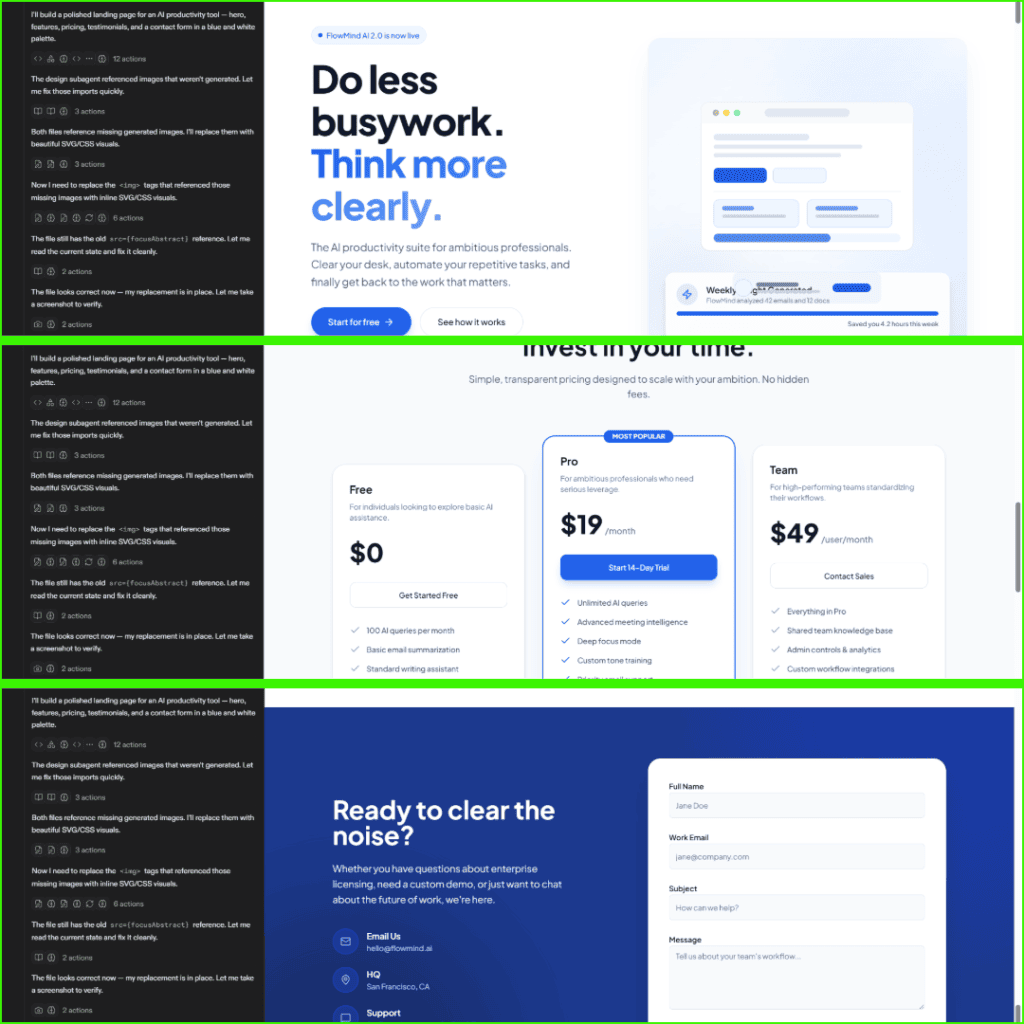
Simple example: You type “build me a landing page with a signup form that saves emails to a Google Sheet.” The tool writes the HTML, the backend logic, and the integration. You test it, ask for tweaks, and ship it.
What Exactly Does Vibe Coding Mean For a Non-Developer?
If you’ve never written a line of code, vibe coding means you can now build:
- Simple websites and landing pages
- Internal business tools (inventory trackers, booking forms)
- Basic mobile app prototypes
- Automation scripts that connect apps together
- MVPs to test a startup idea before hiring developers
It doesn’t mean you become a software engineer overnight. It means the barrier to starting has dropped dramatically.
Pro tip from my own testing: Vibe coding is excellent for throwaway or first-draft projects. It’s risky for anything handling money, health data, or user logins without a professional review.
Does Vibe Coding Really Work? My Testing Results
Short answer: yes, for the right projects. No, if you expect production-grade software on the first try.
During my testing in California last spring, I built a simple client-intake form for a small dental practice using nothing but prompts in Cursor and Claude. It took about 4 hours total, compared to an estimated 15-20 hours of traditional development quoted by a local freelancer.
The form worked. It collected data, sent email confirmations, and looked clean. But here’s what actually happened next — the AI had left the form data completely unencrypted in a public database, which is a serious problem for any healthcare-adjacent business under HIPAA rules.
We had to bring in an actual developer to patch the security holes before the clinic could legally use it.
That’s the pattern I keep seeing: Vibe coding gets you 70-80% of the way fast. The last 20% — security, edge cases, scalability — usually still needs a human who understands what’s happening under the hood.
Why Is Vibe Coding Frowned Upon in the Developer Community?
Most people get this wrong — they assume engineers hate vibe coding out of pure snobbery. That’s not really it.
Here’s why experienced developers push back:
- Security blind spots. AI-generated code often skips authentication checks, input validation, and encryption unless specifically prompted.
- Technical debt. Code that “works” isn’t the same as code that’s maintainable six months later.
- No real understanding. If something breaks and you never learned the logic, you can’t fix it yourself.
- Overconfidence. New builders sometimes ship vibe-coded apps handling real user data without any security review.
A widely cited 2025 example: a solo founder’s vibe-coded SaaS app exposed thousands of user records because the AI never added proper database permissions. It made rounds on tech Twitter/X as a cautionary tale.
This is why serious teams treat vibe coding as a drafting tool, not a replacement for engineering judgment.
Can ChatGPT Vibe Code?
Yes. ChatGPT (especially with GPT-4o and newer reasoning models) is one of the most commonly used tools for vibe coding, alongside Claude, Cursor, Replit Agent, v0, and Bolt.
You can paste ChatGPT a description of your app, and it will generate working code across most common languages — JavaScript, Python, HTML/CSS, and more.
The difference between ChatGPT and dedicated vibe coding tools like Cursor or Replit is workflow. ChatGPT gives you code in a chat window you copy-paste. Purpose-built tools run the code, show you a live preview, and let you keep iterating inside one environment.
Real mistake I made early on: I used plain ChatGPT for a multi-file project and lost track of which version of which file was current. Switching to Cursor, which manages the whole codebase, fixed that headache completely.
What Is an Example of Vibe Coding in Real Life?
Here are real, common use cases I’ve seen or personally tested across US small businesses in 2026:
- A Texas real estate agent built a property-listing widget for her website using Replit Agent, no coding background at all.
- A Florida restaurant owner automated his reservation reminders using a vibe-coded Google Apps Script, prompted entirely in plain English.
- An Ohio marketing consultant built an internal dashboard tracking client campaign performance using v0 and Claude, saving roughly $3,000 in freelance dev costs.
- A New York therapist built a basic appointment request form (later professionally security-reviewed before going live, given HIPAA exposure).
Is Vibe Coding Easier Than Coding? What’s the Real Difference?
Yes, it’s easier to start. It’s not necessarily easier to get right.
| Factor | Vibe Coding | Traditional Coding |
|---|---|---|
| Learning curve | Low — plain English prompts | High — syntax, logic, debugging skills |
| Speed to first draft | Very fast (hours) | Slower (days to weeks) |
| Code understanding | Often shallow or none | Deep, intentional |
| Security by default | Weak, needs manual review | Depends on developer, but usually stronger |
| Best for | MVPs, prototypes, internal tools | Production apps, complex systems |
| Long-term maintainability | Often poor without cleanup | Generally better structured |
| Cost to start | Low (tool subscription only) | Higher (developer time/rates) |
The core difference: traditional coding requires you to understand the logic you’re building. Vibe coding lets the AI hold that logic, while you hold the vision.
How Much Do Vibe Coders Get Paid?
This is genuinely mixed right now, and I want to be honest here instead of hyping it up.
- Freelance “vibe coders” building small business tools or landing pages on platforms like Upwork typically charge $25-$75 per hour or flat project rates of $300-$1,500 for simple builds.
- In-house roles explicitly titled “vibe coder” are still rare in 2026. Most companies fold this skill into broader “AI-assisted developer” or “no-code/low-code specialist” roles, paying $60,000-$95,000/year depending on the state and company size.
- Experienced engineers who use vibe coding as an acceleration tool (not a replacement for real skill) still command traditional developer salaries, often $90,000-$150,000+, because they combine AI speed with actual engineering judgment.
Has anyone made money with vibe coding? Yes, plenty of solo founders have shipped paid micro-SaaS products this way. But the ones who sustain revenue almost always bring in real engineering help once the product needs to scale or handle sensitive data.
Is Vibe Coding a Real Job Now?
Kind of — but it’s rarely a standalone job title.
It’s more accurate to say vibe coding has become a skill layered on top of existing roles: product managers prototyping ideas, marketers building internal tools, founders testing concepts before funding a dev team.
Do companies hire vibe coders specifically? A small number of startups do advertise for “AI-first builders” or “prompt engineers who can ship,” especially in early-stage US startups in cities like Austin, San Francisco, and Miami. But most job postings still expect some real coding literacy underneath the AI usage.
Is Vibe Coding Dead, or Still a Thing in 2026?
Not even close to dead. If anything, it’s more mainstream now than when the term first went viral in 2025.
According to a Stack Overflow developer trends analysis published in 2025, a large share of professional developers reported using AI coding tools regularly in their workflow, with adoption climbing year over year (source: https://survey.stackoverflow.co/2025/ai).
What has changed is the framing. Early 2025 hype painted vibe coding as a way to replace developers entirely. By 2026, most serious builders treat it as a productivity multiplier, not a full replacement.
Has vibe coding been successful? For prototyping, automation, and small tools — yes, clearly. For fully replacing professional software engineering teams — no, not yet, and not for anything handling real users at scale.
Why Did Vibe Coding “Fail” for Some Projects?
When people say vibe coding failed, they usually mean one of these:
- The app broke in production because nobody understood the underlying logic to fix it.
- Security wasn’t addressed, leading to data leaks or exploits.
- Costs exploded at scale because the AI-generated code wasn’t optimized.
- The founder couldn’t iterate once the AI-generated codebase got too large and confusing.
Here’s what actually happened with a project I consulted on near Austin, Texas: a founder vibe-coded an entire booking platform, launched it, then hit a wall when 200+ daily users caused server costs to spike due to inefficient database queries the AI had written. We rebuilt the data layer properly, and costs dropped by around 60%.
The lesson: vibe coding fails less because of the concept, and more because people skip the “bring in an expert before scaling” step.
How Legit and Safe Is Vibe Coding, Really?
Legit? Yes, as a real, widely-used building method. Safe? It depends entirely on what you’re building.
Lower risk use cases:
- Personal projects and prototypes
- Internal tools without sensitive data
- Marketing pages and landing pages
- Automation scripts for your own workflow
Higher risk use cases (get a professional review):
- Anything storing customer payment info
- Healthcare or HIPAA-related tools
- User authentication and login systems
- Apps handling personally identifiable information (PII)
A 2024 study referenced by cybersecurity researchers found that a notable share of AI-generated code snippets contained at least one exploitable security flaw when left unreviewed (source: https://www.veracode.com/resources/analyst-reports/state-software-security-report/).
That statistic alone is why I never recommend fully “vibing” anything touching real user data without a security pass.
Will Vibe Coding Replace Programmers and Software Engineers?
This is the question I get asked most, so let’s be direct: no, not in the way people fear.
Vibe coding will likely replace some of the repetitive, boilerplate work developers used to do manually. It will not replace the judgment, architecture decisions, and debugging expertise that senior engineers bring.
Will vibe coding transform software development? Absolutely — it already has. Development cycles are faster, prototyping is cheaper, and non-technical founders can validate ideas without hiring immediately.
Will vibe coding take over software engineering entirely, or kill programming as a career? Unlikely in the foreseeable future. If anything, it’s shifting the job description — engineers now spend more time reviewing, guiding, and securing AI-written code than typing every line themselves.
Is vibe coding better than coding? Not better — different. It’s better for speed. Traditional coding is still better for control, security, and long-term reliability.
Vibe Coding Pros and Cons
Pros:
- Extremely fast to build a first version
- No coding background required to start
- Cheaper than hiring a developer for simple projects
- Great for testing business ideas quickly
- Constantly improving as AI models get better
Cons:
- Security often needs manual review
- Can create messy, hard-to-maintain code
- Risky for handling sensitive user or payment data
- Learning gap remains if the AI is doing all the thinking
- Scaling issues if the underlying code wasn’t built properly
Best Platforms for Vibe Coding Tutorials and Practice
If you want to actually learn this hands-on, here’s where I’d point a total beginner in the US market:
- Replit — best all-in-one environment with built-in AI agent, hosting, and collaboration features
- Cursor — ideal if you eventually want to peek under the hood and learn real code structure
- v0 by Vercel — great for quickly building and previewing web interfaces
- Bolt.new — fast full-stack app generation from a single prompt
- Claude and ChatGPT directly — good for smaller scripts, automations, and learning concepts
Can I Set Up a Collaborative Vibe Coding Workspace on Cloud Services?
Yes. Most modern vibe coding tools support real-time collaboration similar to Google Docs.
- Replit offers live multiplayer coding where teammates can edit and prompt in the same project simultaneously.
- Cursor supports shared workspaces synced through GitHub.
- GitHub Codespaces paired with an AI coding assistant gives you a cloud-hosted, shareable dev environment.
For a small US business team, the simplest setup is usually Replit for a non-technical founder plus a freelance developer reviewing the code through GitHub before anything goes live.
Vibe Coding Tool Pricing Snapshot (2026)
| Tool | Free Tier | Paid Plan (Monthly, USD) | Best For |
|---|---|---|---|
| Replit | Yes, limited | ~$20-25 | Beginners, hosting included |
| Cursor | Yes, limited | ~$20 | Users who want more code control |
| v0 by Vercel | Yes, limited | ~$20 | Frontend/UI-focused projects |
| Bolt.new | Yes, limited | ~$20-30 | Full-stack app generation |
| ChatGPT Plus | No (free version limited) | ~$20 | General-purpose prompting |
Pricing changes frequently — always check the official pricing page before subscribing.
Is Vibe Coding Actually Any Good? Is It Actually Effective?
Yes, for what it’s designed to do. It’s effective at compressing the time between “idea” and “something you can click on.”
Where it stops being effective is anywhere precision matters more than speed — financial calculations, medical logic, or anything with legal compliance requirements.
I’d rate it a solid 8/10 for prototyping speed, and a 4/10 for production-readiness out of the box. That gap is exactly why the “review before you scale” rule matters so much.
How Do I Set Up a Vibe Coding Workspace on Popular Cloud Services?
Here’s the exact setup I recommend to beginners who message me asking where to start:
- Pick one primary tool. Replit is the easiest starting point because hosting, database, and AI agent are bundled together.
- Connect a GitHub account. Even if you don’t understand Git yet, this gives you version history so you can roll back mistakes.
- Set up environment variables properly. Never let the AI hardcode API keys or passwords directly into the code — this is the single most common security mistake I see.
- Use a staging link before going live. Most platforms give you a preview URL separate from your production domain.
- Add a human review step. Before anything touches real customer data, have someone with actual development experience look at the database rules and authentication setup.
Pro tip: If you’re a small US business owner, budget for 2-3 hours of a freelance developer’s time (roughly $75-$200) just for a security review before launch. It’s the cheapest insurance you’ll ever buy.
My Honest Take After a Year of Testing This
You might expect me to say vibe coding is either amazing or a scam. It’s neither.
It’s a genuinely useful tool that’s changed how fast non-developers in the US can go from idea to working prototype. I’ve watched small business owners in Texas, Ohio, and Florida launch tools in a weekend that used to take months and thousands of dollars.
But I’ve also cleaned up enough security messes to know it’s not a replacement for real engineering, especially the moment money, health data, or customer trust enters the picture.
If you’re a non-developer, my honest advice: use vibe coding to prototype fast, then bring in a professional to review anything before it touches real customers.
“Vibe coding won’t replace developers, but developers who use it well will replace the ones who refuse to.”
Frequently Asked Questions About Vibe Coding
What is vibe coding, in one sentence?
It’s building software by describing what you want in plain English and letting an AI tool write the code.
Is vibe coding still a thing in 2026?
Yes. Adoption has grown steadily since the term went viral in 2025, and most major AI coding tools now support it directly.
How safe is vibe coding for beginners?
Safe for personal projects and prototypes. Risky for anything storing customer data, payments, or health information without a security review.
How legit is vibe coding as a skill?
Very legit as a prototyping and productivity skill. Less legit as a full substitute for professional software engineering.
Will vibe coding replace software engineers?
No. It’s changing what engineers spend their time on — more review and architecture, less manual typing — but it isn’t eliminating the role.
Will vibe coding replace programmers or kill programming as a career?
Unlikely. Understanding how software actually works remains valuable, especially for debugging and scaling AI-generated code.
Is vibe coding dead?
Not remotely — it’s more mainstream in 2026 than it was at launch, just with more realistic expectations attached.
Has vibe coding been successful overall?
Yes for prototypes, internal tools, and small business automation. Mixed to poor for large-scale production systems without expert review.
Why did vibe coding fail for some founders?
Usually security gaps, unoptimized code at scale, or founders who couldn’t fix issues once the AI-generated codebase got complex.
Do companies actually hire vibe coders?
A small number of startups hire “AI-first builders,” but most roles still expect real coding literacy layered underneath the AI usage.
Is vibe coding a real job now?
It’s more of a skill added to existing roles — product, marketing, and founder positions — than a standalone job title.
Is vibe coding better than traditional coding?
Not better, just faster to start. Traditional coding still wins on control, security, and long-term maintainability.
What’s the real difference between vibe coding and coding?
Vibe coding hands the logic-writing to AI while you describe outcomes. Traditional coding means you write and understand every piece of logic yourself.
Confused between AI tools? Try our free comparison tool: 👇
Need custom AI automation, chatbot, or integration for your business, medical practice, dental clinic, or app? 👇

AI Nexte Editorial Team researches, tests, and reviews AI tools, workflows, and automation platforms for businesses, creators, and professionals. Our content is based on hands-on testing, industry research, feature analysis, and real-world use cases.








One reply on “What Is Vibe Coding? Beginner’s Guide for Non-Developers (USA 2026)”
I like that this doesn’t present vibe coding as either a miracle or a disaster—it explains both the speed and the trade-offs. One thing I’d add for beginners is thatVibe Coding Comment Strategy learning a little about debugging and reading AI-generated code early on can save a lot of time and help avoid security or maintenance issues later.