



TL;DR: USA personal trainers who use AI for workout programming, nutrition plans, and client check-ins save 5-10+ hours a week and deliver a more responsive experience than trainers running everything by hand. Trainerize, My PT Hub, and PT Distinction now build AI directly into their platforms, and ChatGPT works well as a free starting point. Clients notice the difference — and increasingly expect it.
The Real Reason Trainers Are Losing Clients (It’s Not Their Coaching)
I want to get one thing out of the way first: this isn’t about AI replacing personal trainers. It isn’t, and the data backs that up — industry surveys keep showing that clients still overwhelmingly prefer working with a human coach over an app or chatbot. The trainers losing clients in 2026 aren’t losing them to AI. They’re losing them to other trainers who use AI to run a tighter, more responsive business.
Think about what a client actually experiences with two different trainers. Trainer A sends a workout PDF once a week, texts back a day later, and hands over a generic PDF meal plan they found online. Trainer B delivers programming through an app that adjusts automatically based on logged performance, answers check-in messages the same day with the help of AI-drafted summaries, and sends a nutrition plan tailored to the client’s actual food preferences within minutes of the consult call.
Same coaching skill. Completely different experience. That gap is what’s actually moving clients between trainers right now, and it’s the gap this guide is going to help you close.
What “AI for Personal Trainers” Actually Means in 2026
Before comparing tools, it helps to separate the two very different categories people lump together under “AI for personal trainers”:
- AI fitness apps generate a workout for one person to follow themselves (think Fitbod or similar apps clients might use on their own).
- AI coaching platforms help you, the trainer, deliver personalized programming, nutrition, and communication to a whole roster of clients — with AI doing the first draft so you can focus on judgment and coaching.
If you’re running a training business rather than working out yourself, the second category is what matters. That’s what this guide focuses on.
The AI Tools Personal Trainers Are Actually Using
Rather than a generic list of “top 10 AI tools,” here’s what’s actually built into the platforms USA trainers use day to day, based on how each one handles AI in 2026.
| Platform | AI Features | Best For | Starting Price (USD/mo) |
|---|---|---|---|
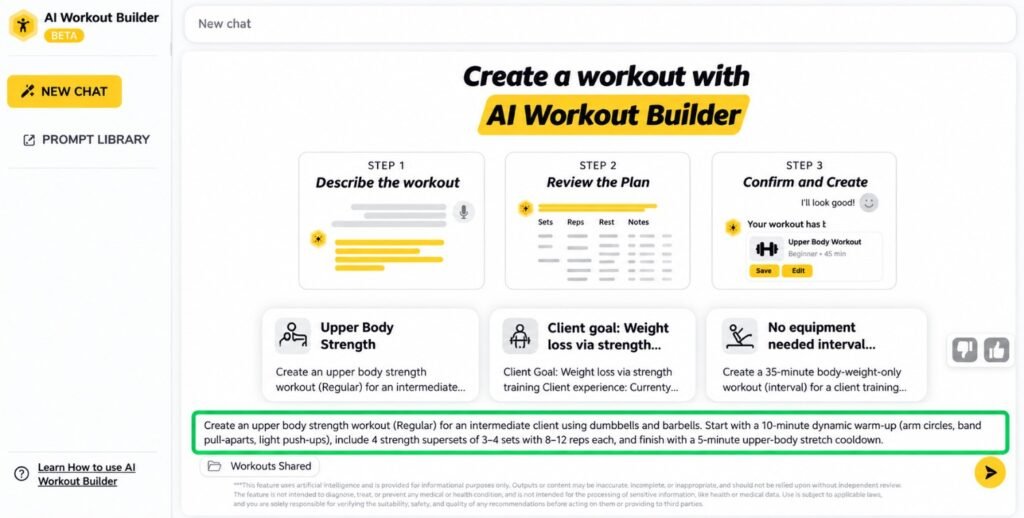
| ABC Trainerize | AI Workout Builder, Smart Meal Planner, automated check-ins | Trainers scaling past 20+ clients who want one all-in-one platform | Free plan (1 client); paid plans from $9, AI nutrition often an add-on |
| My PT Hub | AI-assisted workout builder, Check-Ins AI (automated summaries) | Solo-to-small-team coaches who want AI check-ins without a huge learning curve | Around $25-27 (Check-Ins AI is a paid add-on) |
| PT Distinction | AI Program Builder, AI Meal Planner, AI Marketing Assistant — all included on every plan | Premium, lower-volume rosters where flat pricing with AI included matters | From about $19.90 |
| TrueCoach | Strong client app and video feedback; no native AI program builder | Trainers who prioritize a polished client experience over AI features | From about $19 |
| ChatGPT (general-purpose) | Drafts programs, meal plan outlines, client emails, social captions from your prompts | Solo trainers and new coaches who want to start with something free | Free / $20 for Plus |
A pattern worth noticing: PT Distinction bundles its AI Program Builder, AI Meal Planner, and AI Marketing Assistant into every plan at no extra charge, where Trainerize and Everfit price AI nutrition tools as separate add-ons. That’s a real cost difference if AI is the main reason you’re shopping.
ChatGPT for Personal Trainers: What It’s Actually Good For
You don’t need a $60/month platform to start using AI. A huge number of US trainers are already using ChatGPT as their entry point, and it genuinely works well for a specific slice of the job:
- Drafting a first-pass 4-week program outline that you then adjust for the client’s equipment, injuries, and goals
- Turning a client’s intake form into a plain-English summary of their goals, limitations, and preferences
- Writing check-in messages, onboarding emails, and social media captions in your voice
- Brainstorming exercise substitutions when a client tells you a machine is broken or a movement hurts
Where ChatGPT falls short is anything that needs to see your client’s actual training history, adjust automatically as they log workouts, or sync with payments and scheduling. It has no memory of your roster unless you paste that context in every time, and it can’t verify that a suggested exercise progression is actually appropriate for someone’s real injury history — that judgment still has to come from you. Use it as a fast first draft, not a replacement for your assessment.
If you want a head start, here’s a simple prompt structure that works for most trainers:
“Act as an assistant helping a certified personal trainer. Client profile: [age, goal, experience level, equipment, injuries]. Build a 4-week strength program with 3 sessions per week, including sets, reps, and rest periods. Flag any exercises that might need modification given the injury history above.”
AI for Workout Plan Creation
This is where AI saves the most time, hour for hour. Instead of building a client’s program from a blank template, platforms with an AI program builder pull from the client’s stated goals, equipment access, and (on platforms like Trainerize) their logged performance data to generate a starting program in seconds. You’re still the one deciding whether that program is right — but you’re editing instead of building from zero, which is a completely different time investment across a roster of 20-30 clients.
AI for Nutrition Planning
Nutrition is usually the part of coaching trainers dread doing manually, because it changes constantly and clients rarely stick to a rigid plan. AI meal planners on PT Distinction and Trainerize’s Smart Meal Planner generate a starting plan around a client’s calorie and macro targets, food preferences, and allergies, which you can then adjust rather than write from scratch. This matters most for trainers who aren’t registered dietitians and need to stay in scope — AI can help you produce general, non-clinical nutrition guidance faster, but anything involving a medical condition still belongs with a referral to a registered dietitian or physician.
AI for Fitness Client Management and Check-Ins
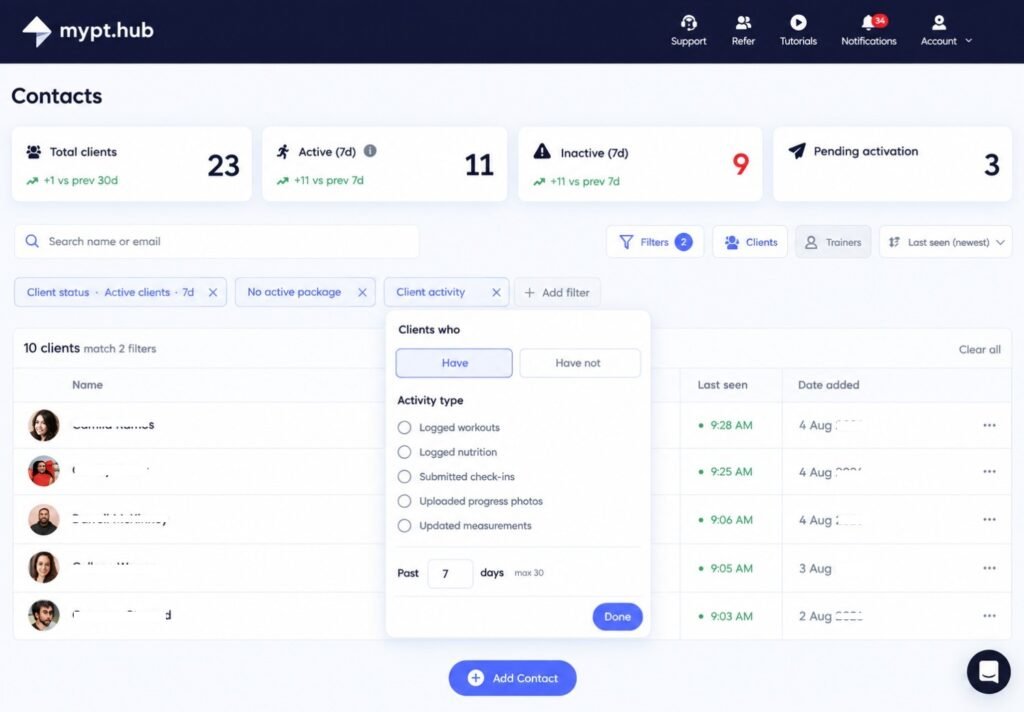
Client check-ins are the single biggest quiet driver of churn. When a client feels like their trainer isn’t paying attention to their progress, they leave — and that’s true even when the programming itself is good. My PT Hub’s Check-Ins AI reads a client’s submitted check-in and drafts a summary and suggested response, so you can review and personalize it instead of writing from a blank page every time. Across a full roster, that’s the difference between same-day responses and messages that sit unanswered for two days.
AI for Fitness Scheduling
Scheduling tools themselves haven’t changed as dramatically as programming and nutrition, but AI-assisted reminders, no-show prediction, and automated rebooking prompts are becoming standard features rather than premium add-ons across most platforms in this space. If admin time is your biggest bottleneck, this is worth checking against your current platform’s feature list before assuming you need a whole new tool. For a broader look at AI tools that cut down admin time generally, our AI productivity tools for 2026 roundup covers scheduling and inbox tools that pair well with a coaching platform.
AI for Gym Marketing in the USA
Getting new clients matters as much as keeping the ones you have. AI tools now help trainers draft social captions, transformation-post copy, local SEO content for “personal trainer near me” searches, and even short video scripts. PT Distinction’s built-in AI Marketing Assistant is aimed squarely at this. If you’re managing your own Instagram or TikTok presence without a marketing background, our guide to AI tools for social media managers is a useful next stop — most of those tools work just as well for a solo trainer’s account as they do for an agency.
Is AI Worth It for Personal Trainers?
For most US trainers running more than a handful of clients, yes — with a caveat. The return isn’t really about the AI feature itself; it’s about what you do with the hours it gives back. A trainer who saves six hours a week on programming and check-ins but doesn’t use that time for client-facing work, sales calls, or actually resting won’t see much business impact. The trainers actually pulling ahead are using AI to reclaim time for the parts of coaching a program can’t replace: noticing when a client’s form is breaking down, having the hard conversation about consistency, and building the kind of relationship that gets referrals.
If you’re a solo trainer or just getting started and want to test the waters before paying for a platform, our list of best AI tools for freelancers in the USA and free AI tools for 2026 are good places to start without committing to a monthly platform fee.
How to Start Using AI as a Personal Trainer
- Pick one workflow, not five. Start with either programming or client check-ins — whichever eats the most of your week right now.
- Try the free tier first. Trainerize has a free single-client plan, PT Distinction and most others offer a free trial, and ChatGPT’s free tier covers a lot of ground before you need to pay for anything.
- Keep a human review step. Never send an AI-drafted program or nutrition plan to a client without reading it yourself first — AI doesn’t know about the shoulder injury your client mentioned three sessions ago unless you tell it.
- Measure the time saved, not just the feature list. Track how many hours a week you actually get back after 30 days before deciding whether to upgrade to a paid AI tier.
- Reinvest the time in client-facing work. The trainers who benefit most from AI use the saved hours for coaching quality and client acquisition, not just working less.
Key Takeaways
- Trainers aren’t losing clients to AI directly — they’re losing them to other trainers who use AI to deliver a faster, more attentive experience.
- Trainerize, My PT Hub, and PT Distinction all now include AI program building; PT Distinction bundles AI features into every plan, while Trainerize and Everfit price some AI tools as separate add-ons.
- ChatGPT is a solid, free starting point for drafting programs, nutrition outlines, and client communication, but it can’t replace a platform that tracks real client data.
- AI check-ins (like My PT Hub’s Check-Ins AI) directly target the client-communication gap that drives a lot of quiet churn.
- The actual ROI of AI depends on what you do with the time it saves — reinvest it in coaching and client relationships, not just admin reduction.
Frequently Asked Questions
Which AI is best for a personal trainer?
There’s no single “best” — it depends on whether you need a full coaching platform or just a drafting assistant. Trainerize and PT Distinction are the strongest all-in-one options with built-in AI program and nutrition tools, while ChatGPT works well as a free starting point for drafting content before you commit to a paid platform.
Can ChatGPT be a personal trainer?
ChatGPT can draft workout and nutrition ideas, but it isn’t a substitute for a certified trainer. It has no way to observe a client’s form, doesn’t know their real injury history unless you tell it every time, and can’t adjust automatically based on logged performance the way a coaching platform can.
Is ChatGPT good for workout plans?
It’s a reasonable first draft for a general program outline, especially for straightforward goals like general strength or fat loss. For clients with injuries, specific sport demands, or complex programming needs, treat its output as a starting point to edit, not a finished plan.
How much does an AI personal trainer app cost?
Entry-level AI-enabled coaching platforms in the USA start around $9-$25 per month for a solo trainer, with mid-tier plans covering 15-50 clients typically running $60-$175 per month depending on the platform and which AI features are included versus sold as add-ons.
What apps do most personal trainers use?
Trainerize, My PT Hub, TrueCoach, and PT Distinction are among the most widely used coaching platforms among US-based personal trainers, alongside general tools like ChatGPT for content drafting and Stripe for payments.
Will AI replace personal trainers?
Industry surveys consistently show clients still strongly prefer human coaching relationships over app-only or AI-only fitness guidance. AI is automating the administrative and drafting side of the job — programming, check-in summaries, marketing copy — not the relationship and judgment side.
How do I make ChatGPT my personal trainer?
Give it detailed context each time: your goals, experience level, equipment, injury history, and how many days a week you can train. Ask for a specific structure (sets, reps, rest periods) and treat the output as a draft to sanity-check against your own knowledge or a certified trainer’s feedback, not a finished program.
Is AI worth it for solo personal trainers?
For most solo trainers with more than a handful of clients, yes — the time saved on programming and check-ins usually outweighs the cost of an entry-level plan, as long as that saved time actually goes back into coaching quality or client acquisition rather than just fewer working hours.
Trainerize AI vs My PT Hub AI: which is better?
Trainerize’s AI Workout Builder and Smart Meal Planner are stronger for trainers who want one platform to scale past 20-plus clients. My PT Hub’s Check-Ins AI is more narrowly focused on automating client communication, which makes it a good fit if check-ins specifically are your biggest time drain.
Where This Leaves You
If you’re still deciding, don’t try to adopt five AI tools at once. Pick the one task eating the most of your week — programming, nutrition, or check-ins — and test a free tier for 30 days before paying for anything. The trainers pulling ahead in 2026 aren’t the ones with the most AI tools installed; they’re the ones who used AI to buy back time and then spent that time on the parts of coaching that actually keep clients around.
Sources referenced: ABC Trainerize 2026 State of the Personal Training Industry Report, NASM 2026 State of the Personal Trainer report, and current 2026 pricing pages for Trainerize, My PT Hub, PT Distinction, and TrueCoach, cross-checked via third-party pricing trackers as of mid-2026.

AI Nexte Editorial Team researches, tests, and reviews AI tools, workflows, and automation platforms for businesses, creators, and professionals. Our content is based on hands-on testing, industry research, feature analysis, and real-world use cases.








No Comments