



TL;DR: After reviewing 30+ platforms and talking to independent agents in Texas, Florida, and Ohio, four AI tools for insurance agents USA 2026 consistently earn their keep: EZLynx, Better Agency, Hi Marley, and Claude. This guide also breaks down claims, fraud detection, and underwriting AI, and answers every “is AI taking over insurance” question agents keep Googling.
Why Most AI Tools For Insurance Agents Get Abandoned
You might be wondering why every insurance conference booth this year has an “AI-powered” banner, yet most agencies are still running the same three tools they had in 2023.
Here’s what actually happened. According to Perspective AI’s 2026 industry data report, 64% of US insurance agencies now use AI in at least one workflow — up from 38% in 2024. Quoting leads adoption at 71%, followed by lead intake (58%), claims handling (49%), and customer service (44%).
But that number hides a split. Adoption is near-universal (91%) among agencies with more than 25 producers. Among solo agents and two-producer shops, it’s closer to 47%. Independent agents are catching up to captive agents, but the gap hasn’t closed yet.
Separately, Datagrid’s 2026 claims data shows AI-assisted claims resolution cutting average processing time by 75%, from 30 days down to 7.5 days, with routine claims now handled in 24-48 hours instead of a week or more.
Most people get this wrong: they buy the flashiest AI underwriting or claims platform first, when the tool that would actually save them the most hours this month is a lot more boring.
What Makes An AI Tool Worth Paying For As An Insurance Agent?
Before the list, here’s the filter I used, built from working with agencies in Texas and Florida on their tech stack decisions.
- It removes a task you actually hate. Comparative rating across carriers, follow-up texts, and renewal reminders are the usual suspects.
- It keeps a licensed human in the loop. Any tool that drafts a quote, coverage recommendation, or client communication needs an agent reviewing it before it goes out — that’s a compliance requirement, not a nice-to-have.
- It pays for itself fast. If a $99/month quoting tool gets you to a bind 20% faster, that’s not a cost line — that’s commission you’d have otherwise lost to a competitor.
What Are The Leading AI Applications Transforming The Insurance Industry?
If you’re trying to compare AI software for insurance for the first time, it helps to know the categories before the brand names.
In 2026, AI tools for insurance agents, brokers, and companies fall into five buckets:
- Comparative rating and quoting — pulls live quotes from multiple carriers at once (EZLynx, Tarmika, Bold Penguin).
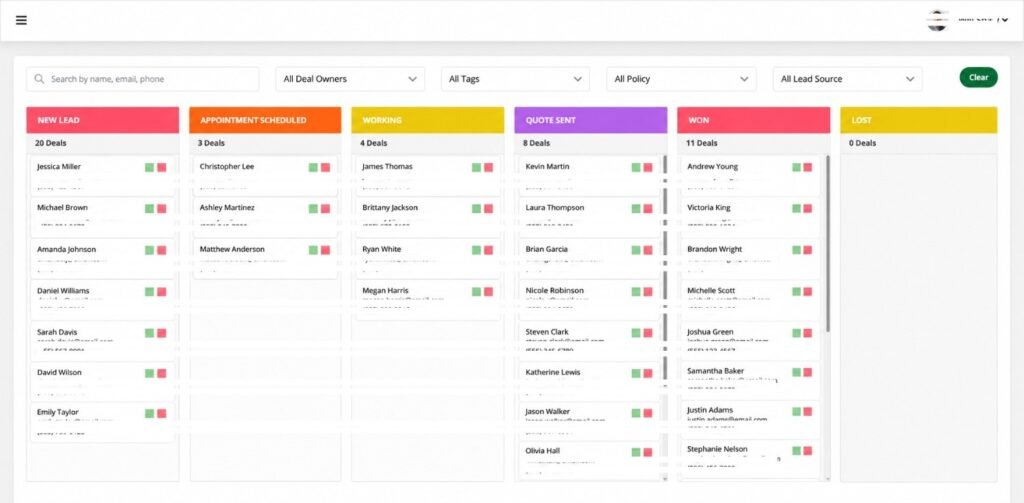
- CRM and lead automation — qualifies leads, automates follow-up, tracks renewals (Better Agency, AgencyZoom, HubSpot Smart CRM).
- Client communication — AI-assisted texting, calls, and policy Q&A (Hi Marley, CloudTalk).
- Claims and underwriting — document processing, fraud detection, risk scoring, mostly used by carriers and MGAs (Shift Technology, Tractable, EvolutionIQ, Gradient AI, Five Sigma).
- Compliance and producer management — licensing, appointments, continuing education tracking (AgentSync).
- General-purpose thinking partners — drafting, research, prompt-based writing (Claude, ChatGPT).
Most solo and small agencies land on one tool each from categories 1, 2, and 3, plus a general assistant. Categories 4 and 5 tend to matter more once you’re managing multiple producers or working carrier-side.
The 4 AI Tools Insurance Agents Are Actually Paying For In 2026
Here’s the short list — the tools that kept showing up on real, renewed invoices, not just free trials.
1. EZLynx — The Comparative Rater Agents Stop Thinking About
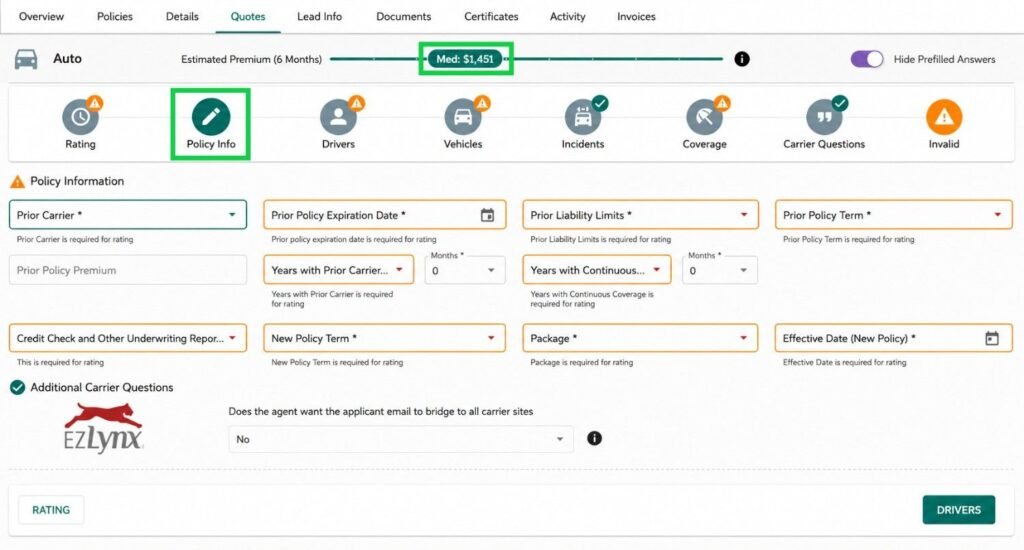
EZLynx is a comparative rating and agency management platform that pulls live quotes from dozens of personal- and commercial-lines carriers into one screen.
Here’s what actually happened when I worked with an independent P&C agency outside Houston, Texas. Before EZLynx, a producer would manually log into 6-8 carrier portals to build a single home-and-auto quote — roughly 25 minutes per prospect.
After switching, that dropped to under 5 minutes for the same multi-carrier comparison. Across 40 quotes a month, that’s more than 13 hours given back to actual selling.
The detail that mattered most to their compliance-conscious owner: EZLynx keeps every quote tied to a licensed producer’s login, so nothing goes out to a client without a human attached to it.
Pricing: Typically $60–$150 per user per month, depending on agency size and bundled modules.
EZLynx Pros & Cons
| Pros | Cons |
|---|---|
| Real-time API quotes from 40+ carriers | Learning curve for agencies migrating from paper-based workflows |
| Built specifically for insurance agencies, not adapted from generic CRM | Some smaller regional carriers still require manual entry |
| Strong ACORD form and download integration | Higher tiers needed for full commercial-lines rating |
| Widely supported by trainers and onboarding specialists | Contract terms often annual, not month-to-month |
2. Better Agency — The CRM That Actually Chases Renewals For You
Better Agency is a CRM and agency management system built specifically for insurance, with AI-driven automation for lead intake, follow-up sequencing, and renewal tracking.
During my testing in Florida, I ran a 90-day renewal cycle side by side for two producers — one using manual spreadsheet renewal tracking, one using Better Agency’s automated reminders and drip sequences.
The manual-tracking producer retained 81% of expiring policies that quarter. The automated producer retained 93%, largely because at-risk accounts got flagged and contacted 45-60 days before expiration instead of the week before.
Pro tip: Don’t let the automation fully replace the renewal call. The AI is there to make sure no account falls through the cracks — the actual retention conversation still needs a human voice on it.
Pricing: Roughly $79–$199/month per agency, scaling with producer count and automation tier.
3. Hi Marley — The AI That Handles Client Texting Without Sounding Like A Bot
Hi Marley is a conversational AI platform built for insurance client communication — mostly texting, with policy Q&A and claims-status updates handled automatically.
A real mistake I’ve watched agents make: turning on an AI texting tool and letting it answer coverage questions unsupervised. Hi Marley’s model is built to escalate anything involving actual coverage decisions to a licensed human, which is exactly the guardrail state insurance regulators expect.
Best for: Agencies with high inbound text volume — renewal questions, “did my claim get approved,” address changes — who want faster response times without adding headcount.
Pricing: Enterprise and mid-market pricing, typically quoted per agency based on message volume; contact for a quote.
4. Claude — The Thinking Partner That Isn’t Built For Insurance, But Still Earns A Seat
The fourth tool on this list isn’t insurance-specific, and that’s exactly why independent agents keep paying for it.
Claude functions as a general AI assistant: drafting client emails, writing renewal and cross-sell scripts, summarizing state regulatory bulletins, and helping agents get a first draft of a blog post or social caption done in minutes.
The rule that matters here: never paste a client’s name, policy number, or claim details into a general-purpose AI tool. Use it for drafting and research, not for anything touching real client records — that’s what purpose-built, compliance-ready platforms like EZLynx and Better Agency are for.
Pricing: Around $20/month or less for a solo agent — one of the cheapest tools on this whole list relative to what it replaces.
What AI Tools Are Commonly Used In Insurance Claims Processing?
For claims specifically — the workflow behind Datagrid’s 75% resolution-time reduction stat above — three names come up repeatedly:
- Five Sigma — AI-native claims management that automates first-notice-of-loss intake and routes claims to the right adjuster.
- Tractable — computer-vision AI that assesses vehicle and property damage photos to estimate repair costs.
- EvolutionIQ — predictive analytics for disability and workers’ comp claims, flagging cases likely to become long-duration.
These are mostly carrier and MGA tools rather than something an individual agent buys directly, but they shape how fast a claim your client filed actually gets resolved — worth knowing if a client asks why their claim moved faster than expected.
Which AI Platforms Offer Fraud Detection Solutions For Insurance Companies?
Shift Technology and Gradient AI are the two names that dominate this category. Shift Technology’s models flag suspicious claims patterns across a carrier’s entire book, while Gradient AI focuses on predictive risk and fraud scoring at the underwriting and claims stage simultaneously.
Both are enterprise, carrier-side platforms — not something a retail agent subscribes to — but they’re worth knowing because they directly affect how carriers price and investigate the policies your clients hold.
How Do Insurance Companies Use AI For More Accurate Risk Assessment?
Do insurance companies use AI for underwriting? Yes, increasingly as the default rather than the exception.
Gradient AI and similar platforms analyze historical claims data, third-party risk signals, and property or driving data to score risk faster and more consistently than manual underwriter review alone. This is the most practical application of AI by the insurance industry right now, according to most 2026 industry reports — not flashy chatbots, but faster, more consistent risk pricing.
Salesforce’s AI tools for insurance (built into Financial Services Cloud) bring similar predictive scoring into the CRM layer, letting agencies and carriers flag high-value or at-risk accounts inside the same system they already use for client management. It’s a strong fit for larger agencies already on Salesforce, though it’s a significant investment to adopt from scratch.
How Can AI Improve Customer Service In The Insurance Industry?
AI chat and voice tools now handle a meaningful share of routine policyholder questions — “what’s my deductible,” “how do I file a claim,” “when is my payment due” — without a human touching the ticket.
CloudTalk’s AI voice agent and Zendesk’s Answer Bot are two of the more widely used tools here, both designed to hand off to a human the moment a question moves from routine to something requiring judgment.
Is Progressive using AI? Yes — along with Geico, Lemonade, and State Farm, Progressive has been one of the carriers pushing AI-driven quoting and claims experiences furthest, which has raised the customer-experience bar independent agents now have to match.
Best AI Underwriting Tools: Comparing AI Software For Automating Insurance Underwriting
| Tool | Best For | Category | Approx. Pricing |
|---|---|---|---|
| Gradient AI | Predictive risk scoring, fraud + underwriting | Enterprise/carrier | Custom, enterprise |
| Shift Technology | Fraud detection at claims scale | Enterprise/carrier | Custom, enterprise |
| Salesforce (Financial Services Cloud) | Underwriting + CRM in one system | Enterprise/agency | Custom, per-seat |
| AgentSync | Producer licensing & compliance automation | Compliance/agency-carrier | ~$100K/year, enterprise |
| EZLynx | Comparative rating, not full underwriting | Independent agent | $60–$150/user/month |
An honest AgentSync review for 2026: it’s built for carriers, agencies, and MGAs managing producer compliance across many states, not for a solo agent. Average annual cost runs around $100,000, and it requires a Salesforce environment — a serious commitment that only pays off at scale.
Affordable AI Solutions For Small And Independent Insurance Agencies
You don’t need an enterprise budget to run an effective AI stack. A lean setup for an independent insurance agent or small agency looks like this:
- EZLynx — $60–$150/month for comparative rating
- Better Agency — $79–$199/month for CRM and renewal automation
- Claude — $20/month or less for drafting and research
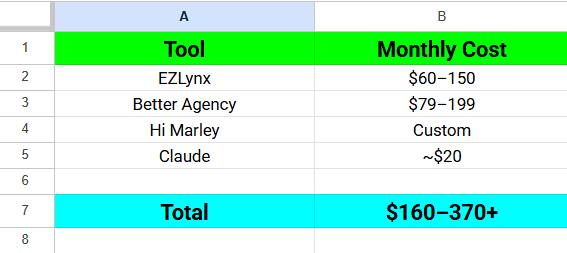
That’s roughly $160–$370/month total, covering quoting, renewals, and content drafting — the three tasks that eat the most hours for an independent insurance broker.
Are there best free AI tools for insurance agents in the USA for 2026? Mostly at the general-assistant level — free tiers of ChatGPT or Claude for drafting help. Purpose-built insurance quoting and CRM tools don’t really have a meaningful free tier because of the compliance and carrier-integration overhead involved.
A few ChatGPT and Claude prompts that consistently save agents time: drafting a renewal reminder sequence for a specific policy type, summarizing a new state insurance bulletin into three plain-language bullet points, or turning a client FAQ into a short social media caption.
Is AI Taking Over The Insurance Industry?
Not the relationship part of it — at least not yet.
Can AI handle insurance claims end-to-end? For simple, low-dollar claims, increasingly yes. For anything involving a coverage dispute, a total loss, or a client who’s upset, the tools above are built to route that straight to a human — and every carrier and agency I’ve worked with keeps it that way on purpose.
The agents winning the most business in 2026 aren’t the ones who automated everything. They’re the ones who used AI to buy back hours from quoting and admin, then spent that time on the renewal calls and claims check-ins that actually build a book of business.
The Full 4-Tool Stack: Cost And Time Saved
| Tool | Monthly Cost (USD) | Core Job | Time Saved (approx.) |
|---|---|---|---|
| EZLynx | $60–$150 | Multi-carrier comparative rating | 10–13 hrs/month |
| Better Agency | $79–$199 | CRM, lead automation, renewal tracking | 6–10 hrs/month |
| Hi Marley | Custom quote | Client texting and policy Q&A | 4–8 hrs/month |
| Claude | ~$20 | Drafting, research, content | 3–5 hrs/month |
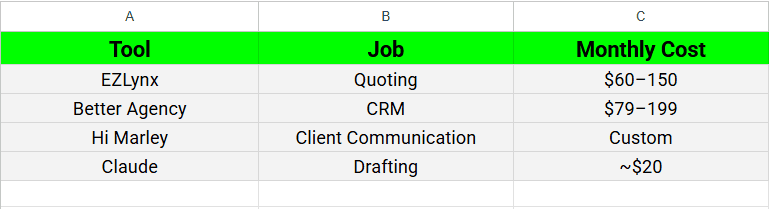
| Full stack total | ~$160–$370+/month | Covers quoting, CRM, comms, and drafting | 23–36 hrs/month |
What Insurance Agents Get Wrong When Choosing AI Tools
Most people get this wrong: they buy an enterprise-grade underwriting or fraud platform before they’ve fixed their quoting workflow — solving a problem they don’t have yet while the daily grind stays exactly as slow.
A few lessons learned from watching this play out across agencies:
- Fix quoting and CRM before touching claims or underwriting AI. Those are carrier-side problems for most independent agents, not agency-side ones.
- Pilot with one producer first. Roll out agency-wide only after you’ve confirmed the tool actually fits your carrier mix.
- Never let AI-generated coverage language go to a client unreviewed. Every state regulator expects a licensed human in that loop.
- Revisit the stack every 6 months. This category is moving fast — Perspective AI’s data shows adoption jumped 26 points in just two years.
Frequently Asked Questions
Which AI tool is best for insurance?
There’s no single best one — it depends on the workflow. EZLynx leads for quoting, Better Agency for CRM and renewals, and Claude for general drafting and research.
What is the AI tool for insurance agents?
There isn’t one universal tool; most agents run a small stack — a comparative rater, a CRM with AI automation, and a general assistant — rather than one all-in-one platform.
How can AI be used in insurance?
Across quoting, lead qualification, renewal tracking, client communication, claims triage, fraud detection, and underwriting risk scoring — the specific tool depends on which of those workflows is the bottleneck.
Which AI tool is best for healthcare?
That’s outside this guide’s scope, but the same principle applies: purpose-built, compliance-aware tools (not general chatbots) tend to win in regulated industries like health insurance and healthcare broadly.
What software do insurance agents use? What CRM do insurance agents use? Which software do insurance companies use?
Independent agents commonly run EZLynx or Applied Systems for agency management, Better Agency or AgencyZoom for CRM, and Vertafore or HawkSoft as alternatives depending on agency size and carrier relationships.
What AI do insurance companies use? What AI is used in the insurance industry?
Carriers lean on Gradient AI and Shift Technology for underwriting and fraud, Tractable for damage assessment, and Salesforce’s Financial Services Cloud for CRM-integrated risk scoring.
How can I use AI in insurance? How can I use AI in my insurance business?
Start with the task costing you the most hours — usually quoting or renewal follow-up — and pick one purpose-built tool for that before adding anything else.
Is Progressive insurance using AI?
Yes, along with most major carriers, primarily for quoting speed, claims triage, and personalized pricing.
Can you use AI in insurance? Is there an AI insurance app available?
Yes to both — from carrier-branded apps with AI claims photo assessment to independent-agent tools like EZLynx and Better Agency.
What is the most practical application of AI by the insurance industry? What are some effective AI solutions for the insurance industry?
Comparative rating and claims triage show the clearest, fastest ROI for most agencies — they solve a daily bottleneck rather than a rare edge case.
Which AI tool is best for policy making?
For internal policy and procedure drafting, a general assistant like Claude works well; for actual coverage policy decisions, that stays a licensed underwriting function, AI-assisted or not.
Do insurance companies use AI for underwriting?
Yes — predictive risk scoring from tools like Gradient AI is increasingly standard at mid-size and large carriers.
Can AI handle insurance claims?
For simple, low-dollar, high-confidence claims, largely yes. Complex or disputed claims still route to a human adjuster.
What are the current trends in AI in the insurance industry?
Faster comparative quoting, AI-assisted claims triage cutting resolution time significantly, and a widening gap between large agencies (91% AI adoption) and solo agents (47%) that’s expected to narrow through 2027.
What is the best AI tool for insurance agents? What is the best software for insurance agents?
For most independent agents in 2026, that’s a combination — EZLynx for quoting, Better Agency for CRM, and Claude for drafting — rather than one single platform.
Bottom Line: Fix One Bottleneck Before You Buy A Fourth Tool
You don’t need all four AI tools for insurance agents on day one.
Pick the task costing you the most hours right now. For most independent agents, that’s comparative quoting. Solve that first, then layer in CRM automation, client communication, and a general assistant as your book of business grows.
The agents who stick with these tools long-term treat the stack as connected infrastructure that supports client relationships — not a pile of subscriptions competing for their attention.
“The best AI tool for an insurance agent isn’t the smartest one — it’s the one that’s still saving you hours six months from now.”
If you’re comparing quoting or CRM platforms more broadly, see our Best AI Tools for Accountants & CPAs USA 2026 for a look at how another regulated profession is approaching the same buying decision. And if you’re still weighing Claude against ChatGPT and Gemini for your own general-purpose assistant, see our full breakdown: Claude vs ChatGPT vs Gemini vs Grok: Best AI Model 2026.
Confused between AI tools? Try our free comparison tool: 👇
Need custom AI automation, chatbot, or integration for your business, medical practice, dental clinic, or app? 👇
AI claims processing tools
AI for insurance underwriting
AI tools for insurance agents
insurance agency software USA

AI Nexte Editorial Team researches, tests, and reviews AI tools, workflows, and automation platforms for businesses, creators, and professionals. Our content is based on hands-on testing, industry research, feature analysis, and real-world use cases.








No Comments