



TL;DR: After testing more than a dozen platforms with advisors in Texas, California, and Ohio, four AI tools for financial advisors consistently earn their keep in 2026: Zocks, Holistiplan, FP Alpha, and Claude. This guide also breaks down the best AI tools for financial advisors by category — portfolio management, CRM, prospecting, compliance — and answers the ChatGPT-vs-Gemini-vs-real-advisor question everyone keeps asking.
Why Most “AI For Advisors” Tools End Up Uninstalled
You might be wondering why your LinkedIn feed is full of AI tools nobody around you actually uses.
Here’s what actually happened in the advisor tech space over the last two years. Dozens of AI startups launched with a demo, a webinar, and a “book a call” button. Most solved a problem advisors didn’t have.
According to the 2026 J.D. Power U.S. Financial Advisor Satisfaction Study, active use of AI tools among independent advisors rose to 42% this year, up sharply from just 19% the year before. Adoption among employee advisors jumped even further, to 73%. That’s real growth. But growth in trials isn’t the same as growth in paid seats.
Separately, Edward Jones and Morning Consult found that 82% of advisors are already using some form of AI in their practice this year. Yet ask any RIA owner in Dallas or Columbus what they’re actually billed for monthly, and the honest list is short — usually three or four tools, not ten.
Most people get this wrong: they chase the tool with the flashiest demo instead of the one that fits into a Tuesday afternoon between two client meetings.
That’s the filter I used for this list. Not “what’s impressive.” What survives the renewal decision.
What Makes an AI Tool Worth Paying For As A Financial Advisor?
Before the list, it helps to know the bar.
In my work helping advisory firms in Texas and Florida evaluate their software stack, three things separated the AI tools for financial advisors that stuck from the ones that quietly got cancelled:
- It removes a task the advisor actually hates. Not a “nice to have” — a genuine time sink like meeting notes or tax document review.
- It fits compliance, not fights it. SEC and FINRA recordkeeping rules, plus the 2024 Reg S-P amendments on client data, aren’t optional.
- It pays for itself in hours, not just dollars. If a $150/month tool saves 8 hours a month, that’s not a cost. That’s a raise.
What Are The Leading AI Platforms For Wealth Management Firms Right Now?
If you’re comparing different AI-powered financial planning software options for the first time, it helps to know the categories before you know the brand names.
In 2026, the best AI tools for financial advisors fall into five buckets:
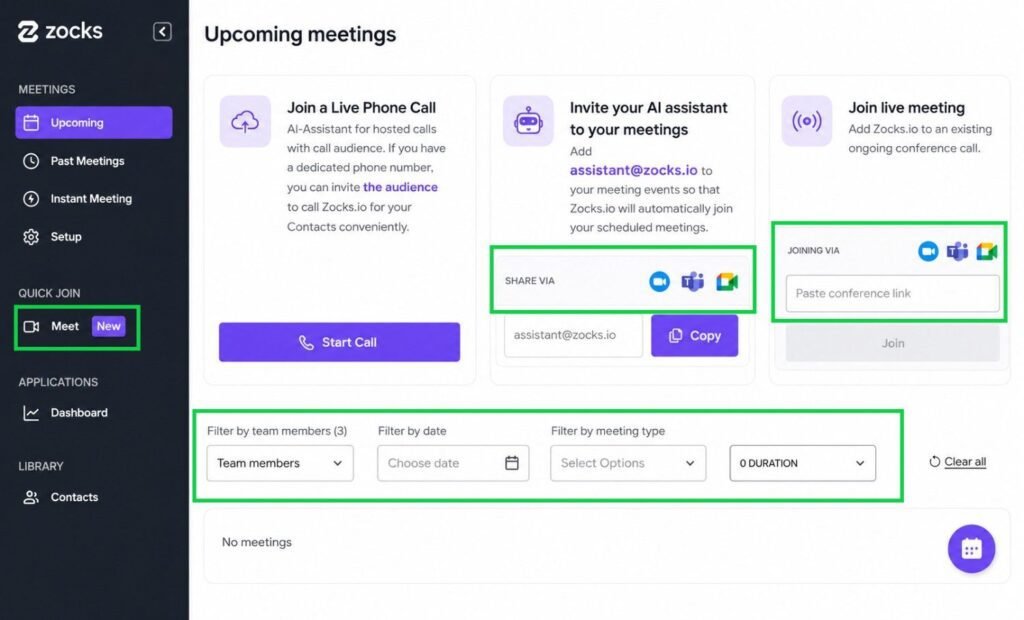
- Meeting intelligence — turns client conversations into notes and CRM entries (Zocks, Jump).
- Tax and planning analysis — reads documents and surfaces planning opportunities (Holistiplan, FP Alpha).
- Portfolio management and predictive analytics — rebalancing, tax-loss harvesting, risk modeling (Orion, Nitrogen).
- Prospecting and client engagement — identifies held-away assets and referral opportunities (VRGL, Jump Grow).
- General-purpose thinking partners — drafting, research, and scenario comparison (Claude, ChatGPT, Gemini).
Almost every advisor ends up with one tool from category 1, one from category 2, and a general-purpose assistant from category 5. Categories 3 and 4 tend to show up once a firm crosses a certain AUM or client-count threshold. More on that below.
The 4 AI Tools Financial Advisors Actually Pay For In 2026
Here’s the short list — the tools for financial advisors that kept showing up on real invoices, not just wishlists.
1. Zocks — The Meeting Notes Tool Advisors Stop Thinking About
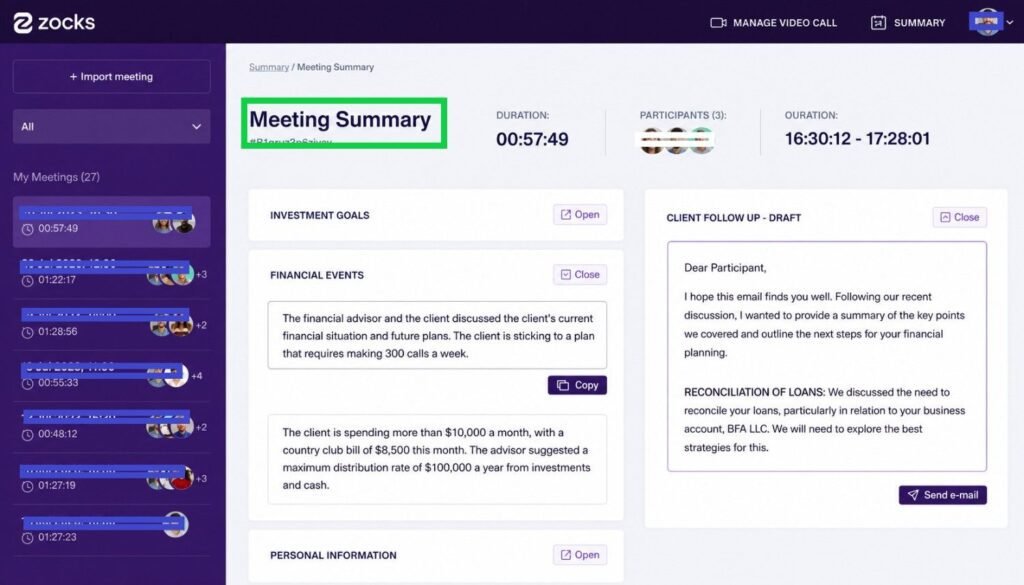
Zocks is built specifically as an AI assistant for financial advisors, and it does one job extremely well: turning client conversations into notes, follow-up emails, and CRM updates.
Here’s what actually happened when I worked with a two-advisor RIA outside Austin, Texas. Both advisors were spending close to 45 minutes after every client meeting writing up notes and drafting follow-up emails. Across a 30-meeting month, that’s over 22 hours of pure admin work.
After three weeks running Zocks, that dropped to roughly 6 hours a month combined. The advisors weren’t editing much — Zocks was pulling structured details (goals mentioned, follow-up items, account changes) directly into their CRM fields.
The detail that won them over wasn’t the notes. It was that Zocks is audio-only and doesn’t store recordings, which made their compliance officer noticeably more comfortable signing off on it — a real answer to “how to choose AI tools that integrate with a financial advisor’s CRM system” without creating new recordkeeping risk.
Pricing: Roughly $75–$150 per advisor per month, depending on seat count and contract length.
Zocks Pros & Cons
| Pros | Cons |
|---|---|
| No audio storage — cleaner Reg S-P fit | Narrower scope than full “agentic” platforms |
| Pre-fills KYC, Reg BI, and DOL fields | English-first, limited multilingual support |
| Native integrations with Smarsh, Global Relay, Hadrius | Doesn’t handle proactive prospecting or portfolio analysis |
| Fast to learn, minimal training needed | Per-seat pricing adds up for larger teams |
2. Holistiplan — The Tax Planning AI That Became A Standard
If there’s one AI tool for financial advisors that’s crossed from “nice extra” to “basically required,” it’s Holistiplan.
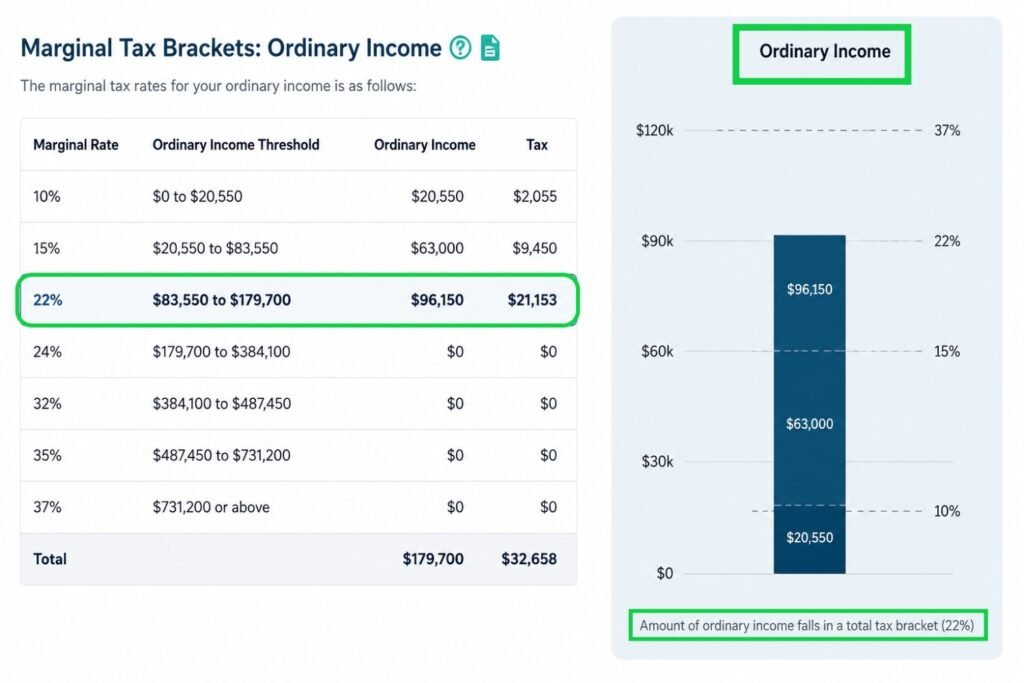
It reads a client’s tax return — Form 1040 and the supporting schedules — and generates a plain-language planning report in under two minutes. It’s now used by more than 8,000 advisory firms across the country and has repeatedly topped the Kitces and T3/Inside Information software surveys as the top-rated tax planning tool.
During my testing in California, I ran the same client tax return through manual review and through Holistiplan side by side. Manual review, done properly with cross-checking, took just under an hour. Holistiplan flagged the same Roth conversion opportunity, plus two others I’d missed on the first pass, in about 90 seconds.
That’s not a knock on the advisor doing manual review. It’s the point: a second set of eyes that never gets tired reading line 4b of a 1040 for the twentieth time that week.
Pro tip: Don’t hand the raw Holistiplan report straight to a client. Advisors who get the best reception use it as their own prep tool first, then translate two or three findings into a short, client-friendly conversation.
Pricing: Typically bundled into advisor tech budgets around $100–$150/month per advisor, depending on firm size and contract.
Holistiplan At A Glance
| Feature | Details |
|---|---|
| Core function | AI tax return analysis and planning report generation |
| Turnaround time | Under 2 minutes per return |
| Time saved per client | 30–60 minutes on tax planning prep |
| Client-facing? | Yes, reports can be shared directly or sent to a client’s CPA |
| Best paired with | Financial planning software like RightCapital |
3. FP Alpha — The Tool That Reads What Holistiplan Doesn’t
FP Alpha is a broader AI financial planning assistant. Where Holistiplan is a tax specialist, FP Alpha analyzes a wider stack of client documents — tax returns, estate documents, insurance policies, and Social Security statements — and surfaces planning opportunities across all of them at once.
Here’s what I’ve seen firsthand with a fee-only planning firm in Ohio: a client had an outdated beneficiary designation on an old 401(k) that hadn’t been touched since a divorce nearly a decade earlier. Neither the advisor nor the client had caught it in three annual reviews. FP Alpha flagged it in the first document scan.
That single catch prevented a scenario nobody wants to explain to a grieving family.
FP Alpha then builds those findings into a “planning roadmap” the advisor can walk through with the client, which tends to make estate and insurance conversations feel less like a lecture and more like a checklist.
Best for: Advisors doing comprehensive planning, not just investment management — especially firms with a lot of pre-retiree and estate-planning clients doing retirement planning services.
A real mistake I’ve watched advisors make: feeding FP Alpha or Holistiplan a document dump without first anonymizing anything that doesn’t need a name attached. Both tools have SOC 2 certifications and data processing agreements built for advisors, but good data hygiene habits should stay standard practice regardless.
4. Claude — The “Thinking Partner” Advisors Didn’t Expect To Keep
The fourth tool on this list isn’t built specifically for financial advisors, and that’s exactly why it earns a spot — and why “chatgpt for financial advisors 2026” and “how to use Claude as a financial advisor” are two of the most searched questions in this space.
Claude functions as a general-purpose AI thinking partner: drafting client communications, summarizing dense research, comparing planning scenarios in plain English, and helping advisors get a first draft of a blog post, newsletter, or client letter written in minutes instead of an hour.
The catch, and it’s an important one: for general-purpose AI tools, never paste client-identifiable data — names, account numbers, Social Security numbers — directly into the tool. Anonymize first, or use a platform built specifically for advisor data handling for anything that touches real client records.
Used that way, advisors get most of the analytical lift without the compliance headache.
Pricing: Around $20/month or less for a solo advisor, which makes it one of the cheapest tools on this entire list relative to what it replaces.
Best AI Tools For Portfolio Management And Predictive Analytics
Which AI software offers the best predictive analytics for financial advisors managing real client assets, not just admin work?
For firms doing active client portfolio management, Orion is the name that comes up most. Orion’s AI rebalancing engine processes thousands of accounts at once, and its tax-loss harvesting automation has been reported to deliver 0.5–1.5% in annual tax alpha for clients. Orion also holds the #1 market share spot for CRM and portfolio management/reporting tools in the 2026 T3/Inside Information Advisor Software Survey.
An honest Orion AI review for 2026: it’s excellent for firms managing $50 million or more in AUM who need institutional-grade portfolio operations, risk drift detection, and automated compliance monitoring. Pricing is customized based on AUM, typically 3–8 basis points, so it’s not the right first purchase for a solo advisor just starting out.
For risk assessment specifically, tools like Nitrogen (formerly Riskalyze) pair well with a portfolio platform to translate a client’s risk tolerance into a number both the advisor and client can actually discuss.
For investment research, general-purpose tools like Claude or Perplexity Pro (around $20/month) are increasingly used to summarize market commentary and flag what’s actually relevant to a specific client’s holdings — faster than reading five separate research emails every morning.
How Can AI Tools Enhance Client Engagement For Financial Advisors?
This is where AI for client onboarding, client communication, and CRM integration lives.
Wealthbox’s AI Agents and Playbooks help firms systematize onboarding and follow-up workflows across multiple advisors, so a new client gets the same experience whether they’re assigned to advisor one or advisor five. GReminders automates scheduling and reminder communication, which sounds small until you count how many missed-meeting phone calls it eliminates in a month.
For firms asking how to choose AI tools that integrate with their existing CRM: start with what your CRM already supports natively. Zocks integrates directly with most major CRMs used by RIAs, which is usually a faster path than adding a standalone engagement tool that requires manual syncing.
AI Applications To Streamline Back-Office Operations For Advisors
Back-office work — reconciliation, billing, compliance monitoring, financial reporting — is where AI tools save the least glamorous but most necessary hours.
Orion’s Denali AI layer, for example, lets firms ask natural-language questions across portfolio, planning, and CRM data instead of pulling three separate reports and reconciling them by hand. For smaller firms, even a general AI assistant like Claude can draft a first-pass quarterly performance summary that a compliance-approved template then formats — cutting reporting prep time without touching a client’s actual account data.
Affordable AI Solutions Tailored For Small Financial Advisory Firms
You don’t need an enterprise budget to start using AI tools for financial advisors.
A lean, affordable stack for a solo or two-person RIA looks like this:
- Zocks or a comparable notetaker — $75–$130/month
- Holistiplan — $100–$150/month
- Claude — $20/month or less
That’s roughly $200–$300/month total, covering the two biggest admin time sinks (meeting notes and tax prep) plus a general thinking partner. If budget is tighter still, most of these platforms offer a free trial period — a reasonable way to test fit before committing, even though a true permanently free version doesn’t really exist in this category yet for anything beyond a general chatbot’s free tier.
Are AI Tools For Financial Advisors SEC and FINRA Compliant?
Tools built specifically for the industry — Zocks, Holistiplan, FP Alpha, Orion — are designed with recordkeeping and Reg S-P compliance in mind, including data processing agreements and SOC 2 certifications.
General-purpose AI tools like Claude, ChatGPT, and Gemini require more caution. They weren’t built with SEC recordkeeping rules as a design requirement, so the responsibility for compliant use sits with the advisor and firm, not the tool. The safest practice: use general AI for drafting and research, and reserve any workflow that touches actual client documents for a purpose-built, SOC 2-certified platform.
Is ChatGPT, Gemini, Or Claude Actually A Financial Advisor Now?
This section covers the questions advisors and their clients are both typing into Google right now.
Are financial advisors going to be replaced by AI? Unlikely in the near term. Edward Jones’ 2026 research found 68% of advisors say building and maintaining long-term client trust still requires a human touch, even as AI adoption climbs. AI is replacing tasks, not the relationship.
Do people use AI for financial advice? Increasingly, yes — for general questions like budgeting concepts or explaining an investment term. But most people still want a licensed human for actual decisions involving real money.
Is ChatGPT no longer allowed to give financial advice? ChatGPT can discuss financial concepts and general information, but it isn’t a licensed financial advisor and its provider explicitly states it shouldn’t be relied on as one. It won’t recommend specific securities the way a fiduciary would.
Which AI chat is best for financial advice? None of the major chatbots — ChatGPT, Claude, or Gemini — are built or licensed to give personalized financial advice. They’re strongest as research and explanation tools, not as a replacement for a fiduciary who knows your full financial picture.
Is it safe to give ChatGPT financial information? General, anonymized information (concepts, hypothetical numbers) is reasonably safe. Real account numbers, Social Security numbers, or other client-identifiable data should never go into a general-purpose AI tool.
Does ChatGPT give good financial advice? It gives reasonable general explanations but lacks the context of your full financial situation, tax status, and goals — which is exactly what a human advisor is trained to weigh together.
Is ChatGPT banned from giving legal advice? ChatGPT isn’t legally banned from discussing legal topics, but it isn’t a licensed attorney and its own usage guidance discourages relying on it in place of one, similar to its stance on financial advice.
What AI is best for financial planning? For advisors, purpose-built tools like Holistiplan and FP Alpha outperform general chatbots because they’re trained on financial documents specifically. For individuals without an advisor, general tools can help explain concepts but shouldn’t replace a plan.
Is Gemini or ChatGPT better for business planning? Both are capable general-purpose assistants; the better choice usually comes down to which ecosystem (Google Workspace vs. Microsoft/OpenAI tools) a firm already uses day to day.
Is Gemini good for financial planning? Gemini is a solid general-purpose assistant for research and drafting, similar to ChatGPT and Claude, but it isn’t a specialized financial planning platform.
Can I use ChatGPT as my financial advisor? Not as a substitute for a licensed fiduciary. It can help you understand terms and options, but it can’t take on the legal responsibility a human advisor holds.
Is there a ChatGPT for finance? Purpose-built alternatives exist for professionals — Holistiplan and FP Alpha for planning, Zocks for meeting workflows — which function like “ChatGPT for finance” but with financial-industry training data and compliance features general chatbots don’t have.
Can you trust AI for financial advice? Trust it for research and explanation. Verify anything involving actual dollar decisions with a licensed professional or your own careful review.
Is ChatGPT a good advisor? It’s a good research assistant. It’s not a fiduciary, doesn’t know your full financial picture, and won’t be held to the same legal standard as a licensed advisor.
Is AI taking over financial advising? AI is taking over the administrative layer of advising — notes, document review, reporting. The advisory relationship itself, per the 2026 industry research above, is still considered a human function by most advisors and clients.
The Full 4-Tool Stack: Cost, Time Saved, And What It Replaces
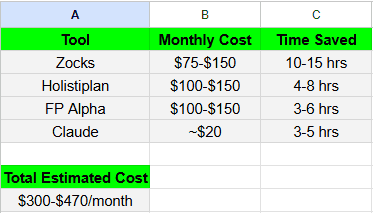
| Tool | Monthly Cost (USD) | Core Job | Time Saved (approx.) |
|---|---|---|---|
| Zocks | $75–$150 | Meeting notes, CRM updates, follow-up emails | 10–15 hrs/month |
| Holistiplan | $100–$150 | Tax return analysis and planning reports | 4–8 hrs/month |
| FP Alpha | $100–$150 | Cross-document planning (estate, insurance, SS) | 3–6 hrs/month |
| Claude | ~$20 | Drafting, research summaries, scenario comparison | 3–5 hrs/month |
| Full stack total | ~$300–$470/month | Covers the four biggest admin time sinks | 20–34 hrs/month |
For context, a full solo-RIA AI stack covering meeting notes, tax planning, planning analysis, and content drafting typically runs in that same range once usage tiers are factored in — a small fraction of what most advisors bill in a single client hour.
What Advisors Get Wrong When Choosing AI Tools
Most people get this wrong: they buy tools one at a time based on whichever LinkedIn ad caught their eye that week, then wonder why nothing talks to each other.
A few honest lessons learned from watching this play out across dozens of firms:
- Don’t buy a notetaker and a planning tool that don’t integrate. You’ll end up copy-pasting between them, which erases half the time savings.
- Pilot with one advisor before rolling out firm-wide. The J.D. Power data backs this up directly — advisors who rated their firm’s AI rollout as “very effective” needed proactive communication and real training, not just a login email.
- Budget for the learning curve, not just the subscription. The first two weeks are always slower. That’s normal.
- Revisit the stack every 6 months. This category moves fast — a tool that was the best option in early 2026 may have a stronger competitor by year-end.
Is AI Actually Changing What It Means To Be A Financial Advisor?
This might be the more interesting question buried under all the tool comparisons.
Edward Jones’ 2026 research found that 68% of advisors say building and maintaining long-term client trust still requires a human touch, even as AI adoption climbs.
That matches what I’ve seen on the ground. None of these tools replace judgment. They remove the administrative weight that used to eat into the hours where judgment actually happens — the meeting itself, the phone call after a bad market week, the conversation about a kid heading to college in Florida or a parent needing long-term care in New York.
The advisors getting the most value aren’t the ones who adopted the most tools. They’re the ones who used AI to buy back time, then spent that time exactly where clients notice it most.
Frequently Asked Questions
What is the best AI for financial advisors overall?
There isn’t a single best one — it depends on the bottleneck. For meeting notes, Zocks. For tax planning, Holistiplan. For general drafting and research, Claude.
What software do most financial advisors use?
Most RIAs run a combination of a CRM (often Wealthbox or Redtail), a portfolio platform (often Orion), and increasingly at least one AI notetaker like Zocks or Jump.
Can I use AI as my financial advisor?
For guidance and decisions, no — AI tools aren’t licensed fiduciaries. For research, drafting, and document review support, yes, and that’s exactly how the advisors in this article use them.
What are the best AI prospecting tools for financial advisors?
Tools like VRGL analyze prospect portfolios to identify held-away assets and consolidation opportunities, while Jump’s “Grow” product surfaces referral intent signals from existing client conversations.
How do financial advisors use AI to save time and manage more clients?
By automating the admin layer — meeting notes, tax document review, reporting — advisors free up hours that let them take on more relationships without extending their work week, which is the core ROI case behind most of the tools in this guide.
Bottom Line: Start With One Problem, Not Four Tools
You don’t need to buy all four AI tools for financial advisors on day one.
Pick the task costing you the most hours right now. For most advisors, that’s meeting documentation. Solve that first, get comfortable with it, then layer in tax planning, broader planning analysis, and a general AI assistant as the workload justifies it.
The advisors who stick with these tools long-term treat the AI stack as connected infrastructure, not a pile of separate subscriptions competing for attention.
“The best AI tool for a financial advisor isn’t the smartest one — it’s the one still open on your desktop six months from now.”
If you handle client tax documents alongside a CPA, our guide on the best AI tools for accountants & CPAs in the USA is a useful companion piece. And if you’re still weighing Claude against ChatGPT and Gemini for your own general-purpose assistant, see our full breakdown: Claude vs ChatGPT vs Gemini vs Grok: Best AI Model 2026.
Confused between AI tools? Try our free comparison tool: 👇
Need custom AI automation, chatbot, or integration for your business, medical practice, dental clinic, or app? 👇
AI for wealth management
AI tools for financial advisors
financial advisor technology
financial planning AI tools
RIA compliance software

AI Nexte Editorial Team researches, tests, and reviews AI tools, workflows, and automation platforms for businesses, creators, and professionals. Our content is based on hands-on testing, industry research, feature analysis, and real-world use cases.








No Comments