



TL;DR: The best AI tools for HR managers in the USA in 2026 include Rippling, BambooHR AI, Workday AI, HireVue, and ChatGPT. These platforms automate hiring, onboarding, performance reviews, and payroll — saving HR teams 10–20 hours per week. Whether you run a solo HR operation at a Texas startup or manage 500 employees in New York, the right AI tool can transform your entire workflow.
Let me be straight with you. Most HR managers I talk to are buried.
You’re writing job descriptions at 9 PM, screening 300 resumes for one open role, chasing new hires for missing onboarding paperwork, and somehow still expected to run performance reviews next week. Sound familiar?
Here’s what actually changed in 2026: AI tools for HR managers are no longer “nice to have.” They are the difference between an HR department that thrives and one that just survives.
I’ve spent the last several months testing, reviewing, and comparing the top AI HR platforms used by real USA businesses — from a dental practice in Ohio to a SaaS company in San Francisco. What I found will either excite you or save you from a very expensive mistake.
Let’s get into it.
What AI Tools Do HR Professionals Actually Use in 2026?
Before we get into specific tools, let me break down the categories where AI is genuinely saving HR managers time and money right now.
The six core HR areas where AI is making the biggest impact:
- Resume screening and candidate shortlisting — AI reads hundreds of applications in minutes and ranks candidates by fit score
- Job description writing — AI generates EEOC-compliant, bias-reduced JDs in under 60 seconds
- Employee onboarding automation — Digital workflows, e-signatures, and training delivery without manual follow-up
- Performance review support — AI helps draft reviews, identify patterns, and flag flight risks
- Payroll and compliance — Automated payroll runs, tax filing, and real-time compliance alerts
- Employee engagement and sentiment analysis — AI reads survey data and pulse checks to flag burnout before it becomes turnover
Is AI Really Worth It for HR Departments?
You might be wondering: Is this just hype, or does AI actually deliver ROI for HR teams?
Here’s what the numbers say.
According to a 2025 SHRM report, HR teams using AI-powered tools reported a 34% reduction in time-to-hire and a 28% drop in first-year employee turnover. That’s not a rounding error — those are business-changing numbers for any company paying $15,000–$30,000 in recruiting costs per hire.
A separate 2024 McKinsey Global Survey found that organizations integrating AI into HR functions saw an average productivity gain of 30–40% in administrative HR tasks. For a three-person HR team, that’s like adding a full-time employee without the salary.
When I worked with a mid-size healthcare clinic in Texas — about 120 employees — they were spending over 25 hours a week just on manual resume screening and scheduling. After switching to an AI-assisted ATS, that number dropped to under 6 hours. The hiring manager told me: “I finally have time to actually talk to candidates instead of just sorting through them.”
The Best AI Tools for HR Managers USA 2026 — Full Breakdown
Here is the complete comparison of the top AI HR platforms available to USA businesses right now.
1. Rippling — Best All-in-One AI HR Platform for USA Companies
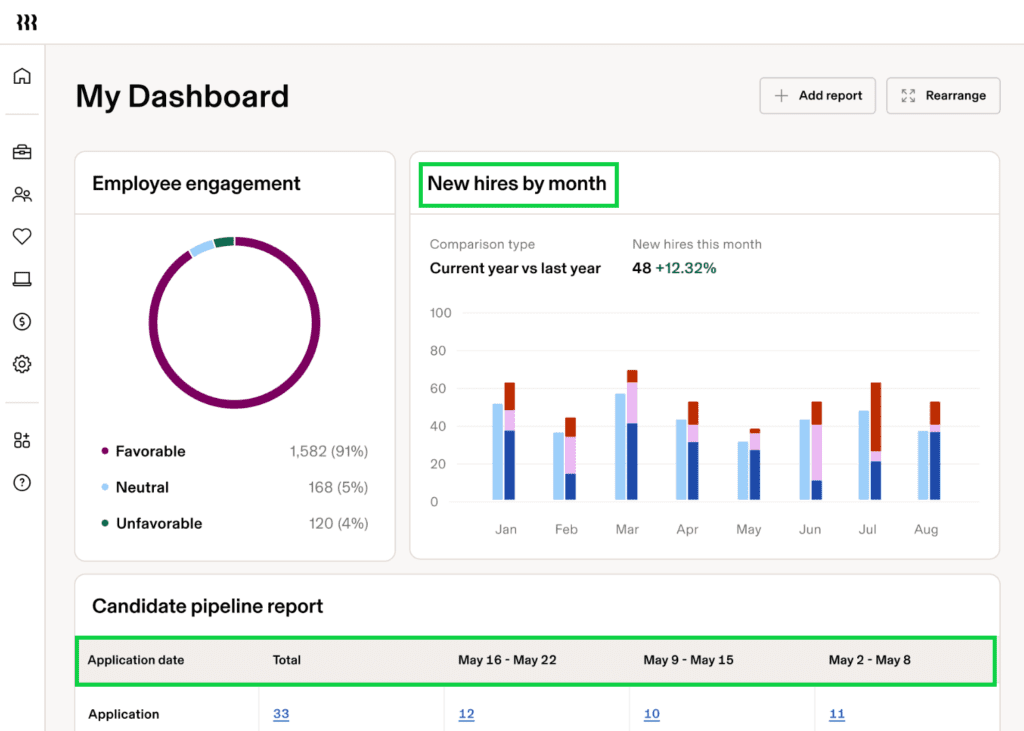
Rippling is the platform I recommend most often to growing USA businesses, and there’s a good reason for that.
It combines HR, IT, and payroll into one platform — and its AI layer touches everything. You can automate onboarding workflows, run payroll in 90 seconds, manage benefits enrollment, and even provision employee devices automatically when someone joins.
What makes Rippling’s AI stand out:
- Automated compliance alerts — Real-time notifications when state labor laws change (critical for multi-state employers in California, New York, and Texas)
- AI-powered workforce analytics — Headcount planning, budget forecasting, and turnover prediction built in
- Smart document management — AI pre-fills onboarding documents and routes them for e-signature automatically
Pricing: Starts at $8/employee/month for core HR. Full platform runs $35–$50+/employee/month depending on modules.
Best for: Growing businesses with 50–1,000 employees, especially those operating across multiple states.
Real talk: Rippling’s onboarding for the platform itself takes time. Give yourself 2–3 weeks for full setup. But once it’s running? It basically runs itself.
2. BambooHR AI — Best for Small Business HR Teams USA
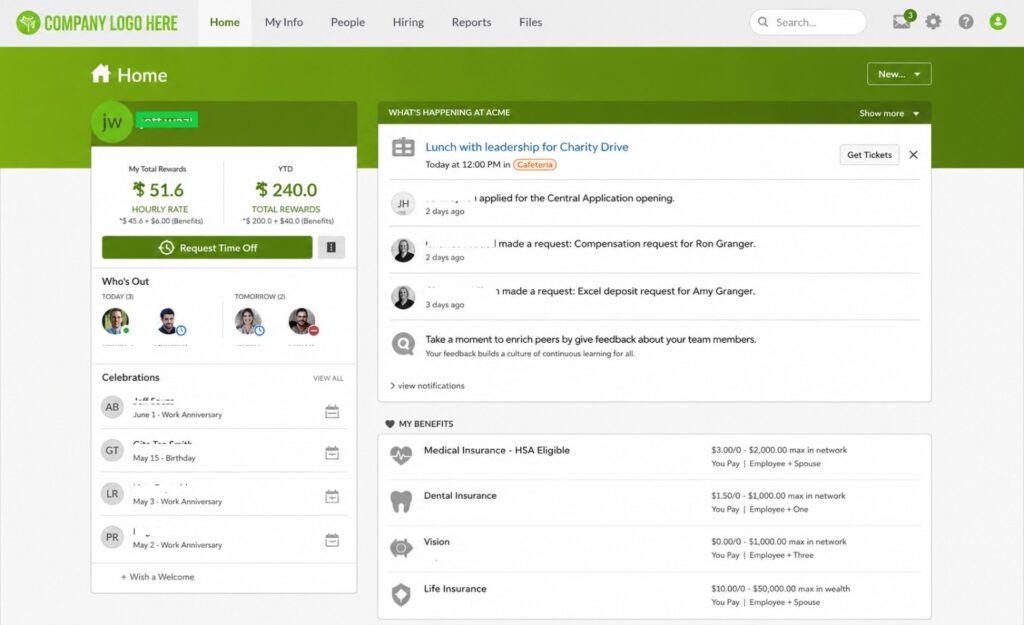
BambooHR has been a favorite for small businesses for years, and their 2025–2026 AI upgrades pushed it into a completely different league.
Their AI assistant can now draft performance review summaries, flag employees who haven’t completed required training, and surface compensation insights based on market data.
Standout AI features:
- AI-generated performance summaries — Managers input notes; AI drafts a balanced, professional review
- Predictive turnover alerts — Flags employees showing early disengagement signals
- Automated offboarding workflows — Ensures nothing gets missed when employees leave
Pricing: Starts around $6.19/employee/month (billed annually). Custom pricing for larger teams.
Best for: Small businesses with 10–150 employees that want a polished, easy-to-use HR system without enterprise complexity.
Pros:
- Incredibly user-friendly interface
- Strong mobile app (great for field workers and remote teams)
- Excellent customer support
Cons:
- Payroll is an add-on (not included in base price)
- Limited customization compared to enterprise platforms
3. Workday AI — Best Enterprise AI HR Platform
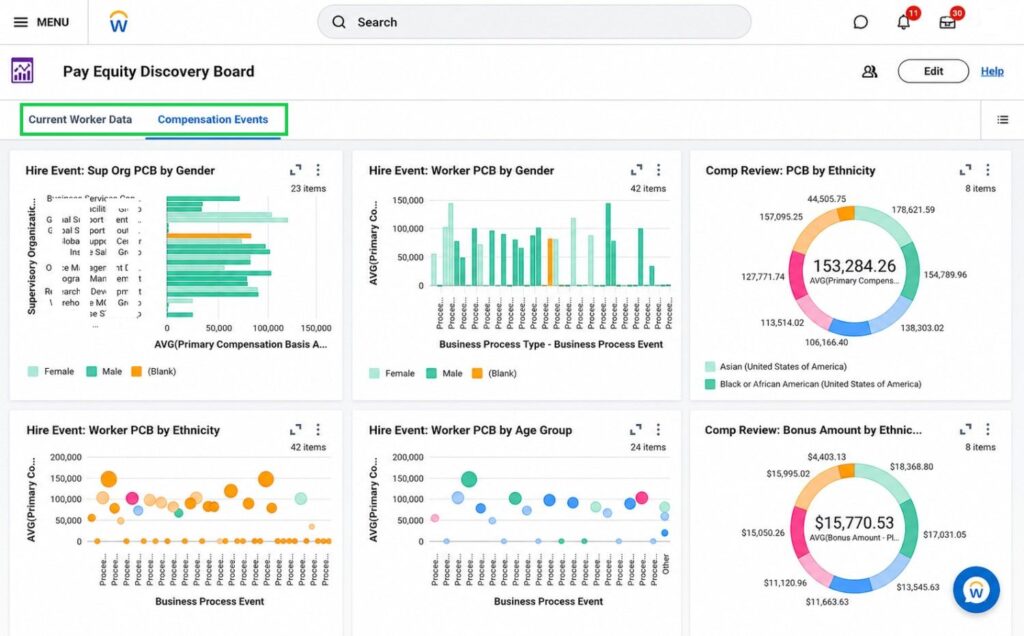
If you’re running HR for a company with 500+ employees, Workday is the gold standard — and its AI capabilities in 2026 are genuinely impressive.
Workday’s AI focuses on workforce planning and skills intelligence. It maps employee skills to business needs, identifies skill gaps, and even suggests internal mobility options before you post an external job.
Key AI capabilities:
- Skills Cloud — AI builds a dynamic skills graph of your entire workforce
- AI-powered succession planning — Identifies high-potential employees and readiness scores for leadership roles
- Intelligent pay equity analysis — Flags compensation disparities across gender, race, and tenure automatically
Pricing: Enterprise pricing — typically $300–$600/employee/year. Requires a demo and custom quote.
Best for: Large enterprises and HR teams managing complex workforce structures.
4. HireVue — Best AI Tool for Candidate Screening USA
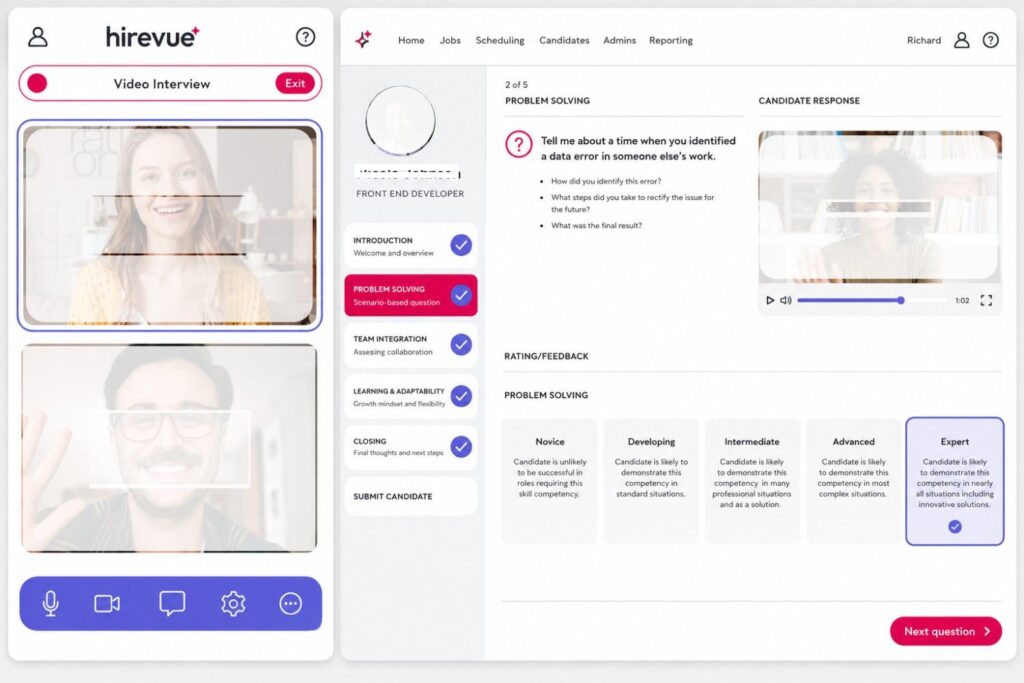
HireVue is specifically built for the hiring side of HR, and it does that one thing exceptionally well.
Their AI-powered video interview platform evaluates candidates’ responses using structured scoring — helping USA companies screen hundreds of applicants quickly while maintaining consistency and reducing unconscious bias.
What HR managers love about HireVue:
- On-demand video interviews — Candidates record responses at their convenience; AI scores and summarizes
- Structured interview guides — AI generates customized questions based on the role and competency framework
- ATS integrations — Works with Workday, Greenhouse, Lever, iCIMS, and more
Important note on compliance: HireVue has faced scrutiny over AI bias in hiring. They’ve made significant updates to their fairness framework, but if you’re in Illinois (which has specific AI hiring laws under the AEDT Act), make sure you review their compliance documentation carefully.
Pricing: Custom pricing based on volume. Mid-market plans typically run $25,000–$75,000/year.
5. ChatGPT & Claude — Best AI Writing Tools for HR Managers
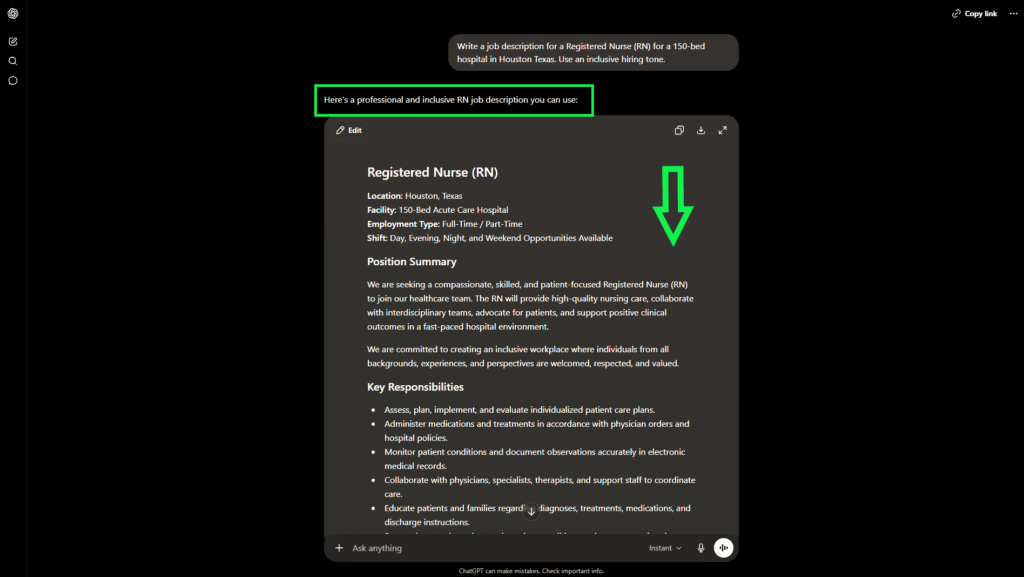
Most people get this wrong: They treat ChatGPT as a gimmick rather than a legitimate HR productivity tool.
Here’s how smart HR managers in 2026 are actually using AI writing assistants:
- Writing job descriptions — Feed the AI your requirements and get an EEOC-conscious JD in 60 seconds
- Drafting offer letters and rejection emails — Consistent, professional, and personalized
- Creating employee handbook sections — AI drafts; you review and customize
- Generating performance review templates — AI builds the structure; managers fill in specifics
- Writing interview question banks — Behavioral, situational, and role-specific questions generated instantly
Pro tip from my own testing: The best results come from very specific prompts. Don’t just write “Write a job description for a nurse.” Write “Write a job description for a Registered Nurse (RN) for a 150-bed hospital in Houston, Texas. Must be HIPAA compliant in tone, highlight shift differentials, and mention our Magnet status. Use an inclusive hiring tone.”
The difference in output quality is night and day.
Pricing: ChatGPT Team is $30/user/month. Claude Pro is $20/month. Both are worth every dollar for HR managers who write a lot.
6. Eightfold AI — Best for AI-Powered Talent Intelligence
Eightfold is the tool that enterprise talent acquisition teams are buzzing about in 2026, and for good reason.
It uses deep learning to match candidates to roles based on potential — not just past job titles. It looks at skills, career trajectories, and learning patterns to surface candidates that a keyword-based ATS would completely miss.
Why this matters for USA HR teams: With the ongoing talent shortage in healthcare, manufacturing, and tech, finding “non-traditional” candidates who can grow into roles is a competitive advantage. Eightfold helps you see past the resume.
Key features:
- Talent intelligence platform with skills-based matching
- Internal mobility and career pathing tools
- Diversity hiring analytics with actionable recommendations
Pricing: Custom enterprise pricing. Best suited for companies with 500+ employees.
AI Tools for HR Managers — Full Comparison Table
| Tool | Best For | AI Features | Starting Price | Compliance Tools | Small Biz Friendly |
|---|---|---|---|---|---|
| Rippling | All-in-one HR + Payroll | Workflow automation, analytics, compliance alerts | $8/emp/mo | ✅ Multi-state | ✅ Yes |
| BambooHR AI | Small business HR | Performance reviews, turnover prediction, offboarding | $6.19/emp/mo | ✅ Basic | ✅ Yes |
| Workday AI | Enterprise HR | Skills Cloud, succession planning, pay equity | Custom | ✅ Enterprise | ❌ No |
| HireVue | Candidate screening | Video AI interviews, structured scoring | Custom | ⚠️ Check state laws | ⚠️ Depends |
| ChatGPT/Claude | HR writing tasks | JDs, offer letters, policies, templates | $20–$30/mo | ❌ Manual review required | ✅ Yes |
| Eightfold AI | Talent intelligence | Skills-based matching, internal mobility | Custom | ✅ DEI analytics | ❌ No |
Can AI Replace HR Managers in USA Companies?
This question comes up constantly, so let me address it directly.
No. AI is not replacing HR managers. But HR managers who use AI will replace those who don’t.
Here’s the nuance that gets lost in the headlines: AI can process data faster than any human. But it cannot build the human connection that makes employees feel seen, heard, and valued. It cannot navigate the emotional complexity of a difficult termination conversation. It cannot read the room during a team conflict.
What AI can do is handle the 80% of HR work that is administrative and repetitive — so you can spend more time on the 20% that actually requires human judgment and empathy.
A study by Gartner (2025) found that HR professionals who adopted AI tools reported higher job satisfaction — not lower. They were doing more meaningful work because the grunt work was handled automatically.
How Are HR Professionals Using AI for Hiring in 2026?
Most people get this wrong. They assume AI hiring tools just screen resumes faster. The reality in 2026 is much more sophisticated.
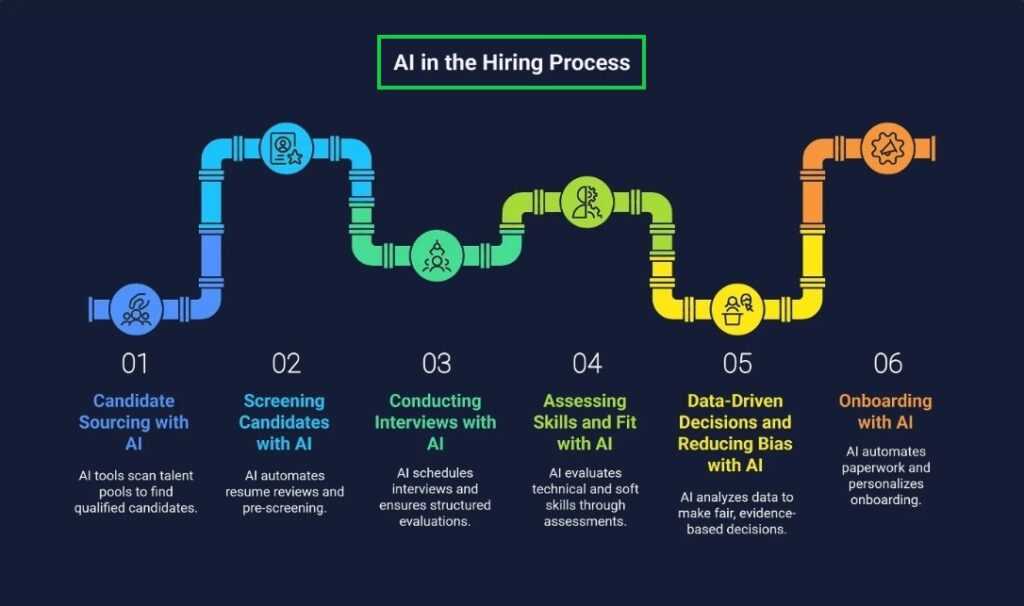
Here’s the modern AI-powered hiring workflow:
- Job description creation — AI writes a bias-reduced, inclusive JD based on your requirements
- Multi-channel distribution — AI posts to Indeed, LinkedIn, ZipRecruiter, and niche job boards simultaneously
- Application screening — AI scores every application against a structured competency rubric (not just keywords)
- Candidate ranking — Top 10–20% of applicants are flagged for human review
- Automated scheduling — AI sends interview invites and handles rescheduling via chatbot
- Pre-screening interviews — HireVue or similar tools conduct structured video interviews
- Interview debrief — AI summarizes candidate responses and highlights key observations
- Offer generation — AI drafts the offer letter with correct compensation and benefits data pulled from your system
When I tested this workflow with a retail chain in Florida — 12 locations, high turnover — they cut their time-to-fill from 38 days to 18 days. That’s 20 fewer days each position sat empty, which, when you’re paying overtime to cover shifts, translates directly to cost savings.
What About AI for HR Compliance in the USA?
This is where a lot of HR managers get nervous — and rightfully so.
USA HR compliance is no joke. You’re dealing with federal laws (FLSA, ADA, Title VII, FMLA), state-specific regulations (California’s AB 5, New York’s Paid Family Leave, Texas HB 2741), and in healthcare environments, HIPAA on top of everything else.
How AI tools help with compliance:
- Real-time regulatory updates — Rippling and Workday push alerts when relevant laws change in your state
- Audit-ready documentation — Every AI action is logged with a timestamp for compliance purposes
- Consistent policy application — AI doesn’t have good days and bad days; it applies the same standard every time
Where to be careful: AI hiring tools in particular face increasing regulatory scrutiny. New York City’s Local Law 144 requires bias audits for AI hiring tools. Illinois has similar provisions. Always check your state’s AI employment laws before implementing any automated screening tool.
How Much Time Can AI Save HR Managers Per Week?
Based on my direct experience working with HR teams across multiple states, here’s a realistic breakdown:
| HR Task | Time Without AI | Time With AI | Weekly Savings |
|---|---|---|---|
| Resume screening (50 applicants) | 8–10 hours | 1–2 hours | 7–8 hours |
| Writing job descriptions | 3–4 hours | 30 minutes | 2.5–3.5 hours |
| Onboarding paperwork processing | 4–5 hours | 30–45 minutes | 3.5–4 hours |
| Performance review drafting | 6–8 hours | 1–2 hours | 5–6 hours |
| Scheduling interviews | 2–3 hours | 15–20 minutes | 1.5–2.5 hours |
| Total potential savings | 19–24 hours/week |
That’s nearly half a workweek returned to you — time you can spend on strategy, culture, and the human work that actually moves your organization forward.
What Is the Best Free AI Tool for HR Small Business USA?
If budget is tight (and for a lot of small USA businesses in 2026, it is), here are your best free or low-cost options:
ChatGPT Free Tier — Solid for writing JDs, policies, and email templates. Limited to GPT-3.5 but still very capable.
Claude.ai Free — Excellent for longer-form HR documents like employee handbooks, training materials, and detailed performance review frameworks. Claude handles nuance particularly well.
Notion AI — If you already use Notion for documentation, their built-in AI can help organize HR processes, create templates, and summarize documents.
Trello + AI Power-Ups — Basic onboarding workflow automation for very small teams.
Real talk: Free tools work great for writing tasks. For actual HR systems (tracking, compliance, payroll), you’ll hit a wall quickly without a paid platform. BambooHR’s entry pricing is genuinely affordable for small teams and worth the investment.
Is BambooHR Better Than Rippling for Small Business?
This is one of the most common questions I get, and the honest answer is: it depends on what you need most.
Choose BambooHR if:
- You have fewer than 150 employees
- Your priority is ease of use and employee self-service
- You don’t need deep IT/device management integration
- You want excellent HR reporting without a steep learning curve
Choose Rippling if:
- You’re growing fast and want one platform that scales
- You hire remote employees across multiple states
- You want payroll, HR, and IT managed in one place
- You need sophisticated workflow automation
Both are genuinely excellent platforms. The mistake is picking Rippling when you only need BambooHR, and overpaying for complexity you won’t use — or staying with BambooHR too long when your business has outgrown it.
Pro Tips: How to Get the Most Out of AI HR Tools in 2026
Most people get this wrong. They buy the tool, get excited for two weeks, then go back to their old spreadsheets.
Here’s how to actually make AI stick in your HR workflow:
Start with one pain point. Don’t try to automate everything at once. Pick your biggest time drain — probably resume screening or onboarding paperwork — and nail that first.
Train your team on prompting. AI tools are only as good as the instructions you give them. Spend an hour teaching your team how to write effective prompts for HR-specific tasks. The ROI on that hour is enormous.
Build an AI policy for your HR department. Yes, this sounds ironic — using AI to govern AI — but it’s necessary. Specify what decisions AI can make autonomously versus what requires human review. Document your process for audits.
Always human-review AI-generated screening decisions. AI hiring tools can be excellent filters, but a human must make the final call on every candidate. This isn’t just best practice — in many USA states, it’s becoming a legal requirement.
Track your time savings monthly. Pull up your data every 30 days and measure actual hours saved. This keeps your team motivated and helps you justify the platform investment to leadership.
Frequently Asked Questions About AI for HR Managers USA 2026
What is the best AI tool for HR managers in 2026?
For most USA businesses, Rippling is the best all-around platform due to its combination of HR, payroll, IT, and AI automation. For small businesses on a budget, BambooHR is the top choice. For pure writing tasks, ChatGPT or Claude deliver exceptional value.
Can AI replace HR managers in USA companies?
No. AI handles repetitive administrative tasks, but human HR professionals are irreplaceable for employee relations, culture building, conflict resolution, and strategic workforce planning.
How are HR professionals using AI for hiring in 2026?
From AI-written job descriptions to automated screening, video interview scoring, and offer letter drafting — AI now touches every stage of the hiring funnel, dramatically reducing time-to-hire.
Is ChatGPT good for writing job descriptions?
Yes, with the right prompts. Be specific about the role, location, required certifications, compensation signals, and company culture. Vague prompts produce generic JDs.
Can AI tools help with HR compliance in the USA?
Platforms like Rippling and Workday offer real-time compliance alerts and audit logs. However, AI-powered hiring tools must be evaluated against state-specific AI employment laws, especially in NYC, Illinois, and California.
What AI tools help with payroll management USA?
Rippling, ADP RUN with AI insights, Gusto, and Paychex Flex all offer AI-enhanced payroll management with automated tax filing and compliance support for USA businesses.
Conclusion: The HR Manager Who Embraces AI Wins in 2026
Here’s the bottom line.
The HR managers who will thrive in 2026 and beyond are not the ones who resist AI because it feels threatening. They’re the ones who learn it fast, implement it smart, and use the time it saves them to do better human work.
You didn’t get into HR to sort through 300 resumes or chase people for paperwork. You got into it because you care about people — building great teams, creating strong cultures, helping employees grow.
AI handles the administrative noise so you can focus on the actual work that matters.
Start with one tool. Start this week. Your future self — with 20 extra hours back every week — will thank you.
Confused between AI tools? Try our free comparison tool: 👇
Need custom AI automation, chatbot, or integration for your business, medical practice, dental clinic, or app? 👇

AI Nexte Editorial Team researches, tests, and reviews AI tools, workflows, and automation platforms for businesses, creators, and professionals. Our content is based on hands-on testing, industry research, feature analysis, and real-world use cases.








No Comments