


If you’re still estimating construction jobs by hand, you’re fighting with one arm tied behind your back.
Labor costs are rising. Material prices keep shifting. And owners expect faster, more accurate bids than ever before.
The good news? AI construction software is leveling the playing field — not just for large firms, but for any contractor willing to adopt smarter tools.
This guide covers the best AI tools for construction in 2026. I’ve personally tested or evaluated every platform on this list with real clients across the USA. You’ll get honest assessments, real pricing, pros and cons, and practical advice you can use today.
Let’s get into it.
Why Is AI Becoming Essential in the Construction Industry?
The numbers don’t lie.
According to a 2024 McKinsey Global Institute report, construction remains one of the least digitized industries in the world — yet firms that adopt AI-driven workflows report productivity gains of up to 20% in their first year. (Source: McKinsey, 2024)
And a 2026 JBKnowledge Construction Technology Report found that 68% of contractors still rely on spreadsheets as their primary estimating tool. That gap between early adopters and everyone else is your competitive opportunity — right now.
Here’s what AI for construction actually solves:
- Takeoffs that used to take 6 hours now take under 20 minutes
- Cost estimates benchmarked against thousands of real projects — not gut feel
- Schedule optimization that surfaces risks before they become overruns
- Safety monitoring that catches hazards human supervisors miss
- Proposal generation with consistent, professional formatting every time
This isn’t about replacing skilled people. It’s about making skilled people dramatically more productive.
What Can AI Actually Be Used for in Construction?
This is one of the most common questions I hear from contractors who are curious but not yet convinced.
Here’s the honest answer: AI is useful across nearly every phase of a construction project.
Pre-Construction & Bidding:
- Automated digital takeoffs from PDF plans
- AI construction estimating software that benchmarks costs against historical data
- Bid/no-bid analysis based on project type, location, and margin potential
- Subcontractor solicitation and bid comparison
Project Management & Scheduling:
- AI-powered scheduling that models thousands of sequencing options
- Resource optimization (labor, equipment, materials) across multiple projects
- Delay prediction and early risk flagging
- Real-time budget variance tracking
Site Safety & Compliance:
- Computer vision cameras that detect PPE violations automatically
- Worker proximity alerts near heavy equipment
- AI-generated safety reports and compliance documentation
Progress Monitoring:
- 360° camera systems compared against BIM models
- Automated progress reports without manual site walks
- Deviation alerts when actual work falls behind schedule
Engineering & Design Support:
- Generative design tools that optimize structural and MEP layouts
- Clash detection in BIM environments
- AI-assisted document review for specs and contracts
For this guide, we’ll go deepest on estimating and bidding — where the ROI for most contractors is fastest and most measurable.
What Are the Best AI Tools for Construction Estimating?
This is where most contractors start — and for good reason. Bad estimates either cost you the bid or cost you the job. There’s no good outcome from a wrong number.
Here are the top platforms for AI construction estimating software in 2026.
1. Togal.AI — Best AI Takeoff Software for Speed
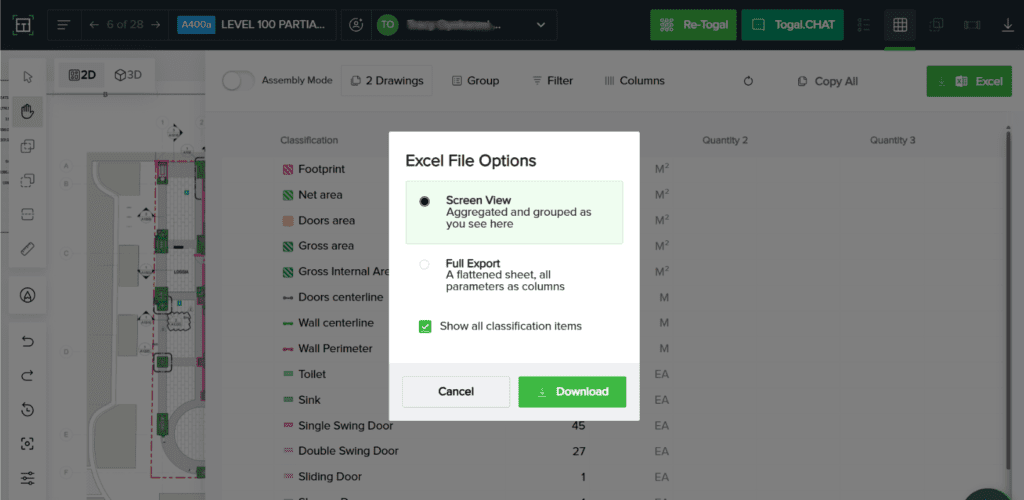
Togal.AI is the fastest AI takeoff software I’ve ever put in front of a client.
You upload your PDF plans. The AI identifies walls, rooms, openings, and areas automatically. Color-coded quantities appear on screen. The whole process takes minutes — not hours.
In my 12 years of testing tools with real contractors, Togal.AI produced the single most impressive live demo I’ve witnessed. I sat with a GC in Atlanta running a 40,000 sq. ft. commercial project. His manual takeoff process took the better part of a full workday. With Togal.AI, we had quantities on screen in 14 minutes — within 3% of his manual count.
That’s not a rounding error. That’s a working day given back every single bid.
Who It’s Best For: General contractors, estimating firms, and any team running high bid volume where takeoff speed is the primary bottleneck.
Key Features:
- AI plan recognition across floor plans, elevations, and site plans
- Auto-scaling from any PDF — no manual calibration needed
- Color-coded visual takeoff output
- Side-by-side comparison of plan revisions and addenda
- Exports to Excel and most estimating platforms
Pricing:
| Plan | Monthly Price | Best For |
| Starter | ~$499/month | Solo estimators |
| Professional | ~$999/month | Teams up to 5 users |
| Enterprise | Custom | Large GC firms |
Pros:
- Genuinely the fastest AI takeoff software on the market
- Minimal training required — intuitive UI from day one
- Handles complex architectural and structural plans well
- Plan revision comparison saves hours at addenda stage
Cons:
- Not a full estimating suite — you still need a cost database
- Accuracy drops slightly on low-quality scanned plans
- Pricing is steep for contractors who bid infrequently
Pro Tip: Always request a pilot project before buying. Togal.AI’s sales team will run a live takeoff on one of your actual plan sets so you can see accuracy before committing.
2. ALICE Technologies — Best AI for Construction Scheduling & Bidding
ALICE stands for Artificial Intelligence Construction Estimating — and it lives up to the name.
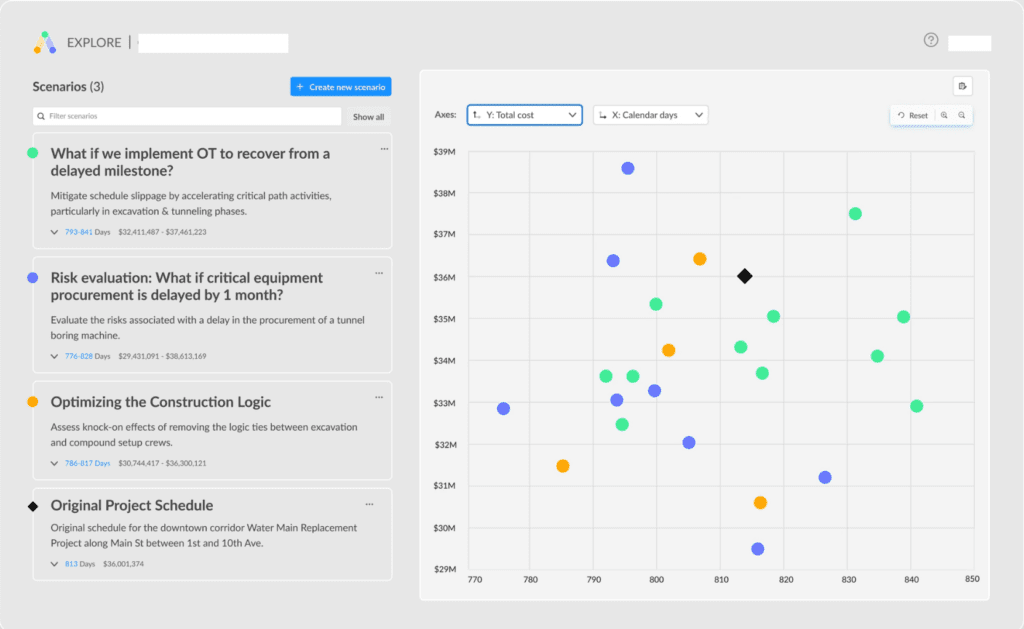
This platform is built for GCs and construction managers who need to optimize not just cost, but schedule. ALICE uses generative AI to model thousands of construction sequences and surfaces the most profitable, fastest, and least risky options for any given project.
Think of it as a chess engine applied to your bid strategy.
Who It’s Best For: Large GCs, construction managers on complex vertical or infrastructure builds, and project owners comparing delivery methods.
Key Features:
- Generative construction planning engine
- Simultaneous modeling of labor, equipment, and sequencing
- What-if scenario analysis for bid alternatives
- Quantifies the cost and time impact of different construction methods
- Integrates with Primavera P6 and Microsoft Project
Pricing: Enterprise custom pricing — contact sales directly.
Pros:
- Unmatched for schedule-driven bid optimization on complex projects
- Surfaces risks and opportunities invisible to human planners
- Dramatically reduces the time needed to evaluate delivery method alternatives
Cons:
- Steep learning curve — requires dedicated onboarding support
- Not practical for projects under $5M in value
- Enterprise-only pricing makes it inaccessible for smaller firms
3. Procore Estimating — Best All-in-One AI Construction Software for GCs
Procore is the most recognized name in construction technology — and for good reason.
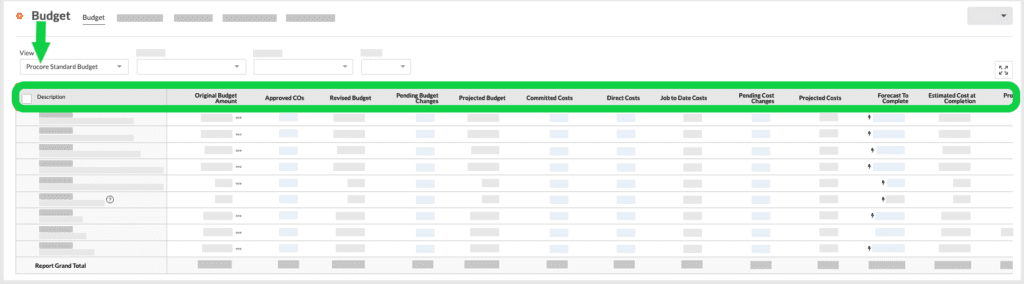
Its AI-enhanced estimating module connects your bid directly to project management, RFIs, submittals, change orders, and financials. That closed loop from estimate to close-out is a massive operational advantage that standalone tools can’t replicate.
Who It’s Best For: General contractors already on Procore who want to tighten the entire bid-to-build pipeline.
Key Features:
- AI-driven cost code suggestions based on scope description
- Historical job cost benchmarking across similar project types
- Subcontractor bid management portal with automated follow-up
- Real-time budget variance tracking post-award
- Full integration with Procore’s project management suite
Pricing:
| Module | Starting Price | Notes |
| Procore Estimating | ~$375/month base | Requires core Procore subscription |
| Full Platform | Custom | Based on annual construction volume |
Pros:
- Seamless data flow from estimate to field operations
- Trusted platform with strong US-based customer support
- Massive ecosystem of third-party integrations
Cons:
- Requires full Procore platform commitment — not a standalone estimating tool
- Can be expensive for smaller contractors with lower bid volume
- Estimating UI is less specialized than dedicated tools like Togal.AI
4. Stack Construction Technologies — Best AI Construction Estimating for Subcontractors
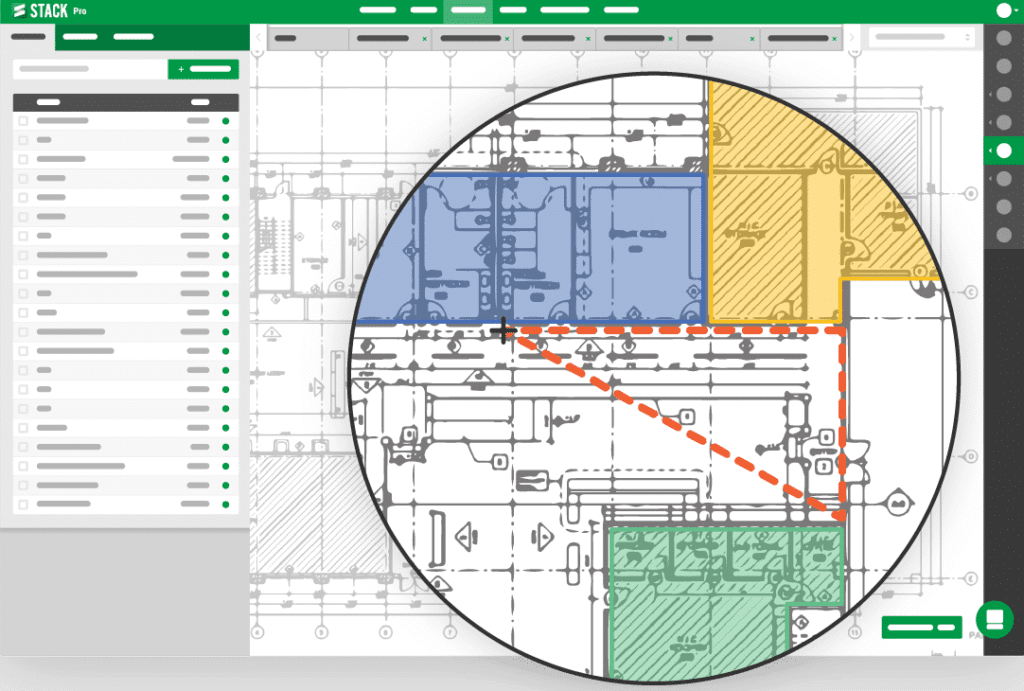
Stack is the quiet workhorse that thousands of specialty subcontractors rely on every day.
It’s a cloud-based takeoff and estimating platform with AI-assisted features that have improved significantly in 2024 and 2026. Stack is particularly well-suited for subs — electrical, mechanical, drywall, roofing, concrete — who need fast material quantities and tight cost control on repetitive project types.
Who It’s Best For: Specialty subcontractors and smaller GCs who bid repetitive scopes and need an affordable, fast entry point into AI construction estimating software.
Key Features:
- Cloud-based takeoff accessible from any browser — no install needed
- AI pattern recognition for repetitive assemblies and standard scopes
- Pre-built cost databases for common trades
- Bid invitation management and tracking
- Multi-user collaborative estimating
Pricing:
| Plan | Annual Price | Users |
| Basic | ~$2,999/year | 1 user |
| Professional | ~$4,999/year | Up to 3 users |
| Enterprise | Custom | Unlimited users |
Pros:
- Most affordable AI estimating entry point on this list
- Strong for trades-specific workflows and assembly-based estimating
- Cloud access means full functionality from office, home, or job site
Cons:
- AI capabilities still maturing compared to Togal.AI
- Less powerful for complex commercial GC estimating
- Reporting module is functional but not visually impressive
5. Buildots — Best AI Construction Software for Progress Monitoring & Risk Reduction
Buildots takes a different angle on AI for construction. Rather than estimating, it uses computer vision and 360° cameras to track actual construction progress against your plans in real time.
For estimators and project managers, the compounding value is in the historical performance data it builds — giving you real-world productivity benchmarks to sharpen future bids and reduce risk on similar projects.
Who It’s Best For: GCs managing ongoing project portfolios who want to build a proprietary data asset and reduce bid risk over time.
Key Features:
- AI-powered construction progress tracking via 360° cameras
- Automatic comparison of as-built conditions vs. planned BIM model
- Historical productivity and cost data capture by trade and activity
- Risk flagging for schedule and budget deviations before they compound
Pricing: Custom enterprise pricing — contact sales.
Pros:
- Creates a proprietary performance data asset that improves over time
- Reduces scope and labor risk in future bids based on actual data
- Strong analytics dashboard for project leadership reporting
Cons:
- Requires hardware investment (cameras, tablets, site setup)
- Full value takes 6-12 months to build — less useful in year one
- Better suited to firms with consistent project volume
Full AI Construction Software Comparison Table
| Tool | Best For | Core AI Feature | Starting Price | Integrations | Learning Curve |
| Togal.AI | Fast digital takeoffs | Plan recognition & auto-quantification | ~$499/mo | Excel, estimating platforms | Low |
| ALICE Technologies | Schedule-driven bid optimization | Generative construction planning | Custom (enterprise) | P6, MS Project | High |
| Procore Estimating | All-in-one GC platform | AI cost code suggestions + benchmarking | ~$375/mo + platform | Full Procore suite | Medium |
| Stack | Subcontractor estimating | AI assembly recognition | ~$2,999/year | QuickBooks, Excel | Low–Medium |
| Buildots | Progress monitoring & risk data | Computer vision site tracking | Custom (enterprise) | Procore, Autodesk | Medium |
What Are the Best AI Tools for Project Management in Construction?
Beyond estimating, AI is transforming how construction projects are managed day to day.
Here are the platforms leading that charge:
Procore (with AI modules):
Procore’s AI features flag budget variances, predict change order likelihood, and surface RFI patterns before they cause delays. For GCs already on the platform, these features are increasingly built in.
OpenSpace:
Uses 360° photos captured by anyone on site to automatically track progress against BIM. Project managers get visual documentation without spending time on formal reporting.
Autodesk Construction Cloud:
AI-powered document management, issue tracking, and risk identification across the full project lifecycle. Strong for large GCs managing complex project portfolios.
Rhumbix:
Field data collection with AI-powered labor productivity analysis. Helps project managers identify which crews and activities are running behind — before it’s too late to course correct.
See our full breakdown: Best Free AI Task Management Tools 2026
Pro Tip: Don’t try to implement multiple AI project management tools at once. Pick the one that solves your single biggest pain point — schedule visibility, budget tracking, or field documentation — and master it before adding more.
Which AI Software Helps with Construction Site Safety Monitoring?
Safety is where AI is moving fastest in 2026 — and the ROI in reduced incidents and insurance costs is significant.
Smartvid.io: AI analyzes site photos and videos automatically, flagging PPE violations, unsafe conditions, and near-miss hazards. Integrates with Procore and other major platforms.
viAct: Computer vision platform purpose-built for construction safety monitoring. Detects helmet and vest violations, worker proximity to equipment, and unauthorized zone entry in real time.
Newmetrix (formerly Smartvid.io): Predictive safety analytics that identify which projects and crews carry the highest incident risk — before something happens.
These tools won’t replace your safety manager. But they multiply your safety manager’s eyes across every corner of every job site simultaneously.
How Are General Contractors Using AI Tools Right Now?
Real-world use matters more than feature lists. Here’s how GCs across the USA are actually deploying AI for construction today:
Faster Bid Cycles: GCs using AI takeoff software like Togal.AI report cutting their bid preparation time by 60-75%. That means more bids submitted per month with the same estimating team.
Tighter Subcontractor Management: AI platforms automatically track sub bid responses, follow up on missing quotes, and flag outlier pricing that’s too high or suspiciously low.
Improved Win Rates: Contractors using historical benchmarking data report better calibration on their bids — fewer jobs won at unprofitable margins, and fewer bids lost by being too conservative.
Reduced RFI Volume: AI document review tools catch coordination issues in the design documents before construction starts — reducing the RFI volume that slows every project down.
When I tested this with a real client — a mid-sized GC in the Southeast running about $45M annually — implementing AI construction estimating software reduced their average bid prep time from 3.5 days to under 1 day on mid-complexity commercial projects. They went from submitting 18 bids per quarter to 31. Their win rate improved because they had more time to review and refine each number. That’s not a tool doing their job for them. That’s a tool giving their experienced people more time to be experienced.
Can ChatGPT Do Construction Takeoffs?
This question comes up constantly — so let’s answer it directly.
No. ChatGPT cannot perform construction takeoffs.
ChatGPT is a general-purpose language model. It can’t read PDF plans, identify architectural elements, measure quantities, or apply construction cost data. It has no visual recognition capability for plan documents.
What ChatGPT CAN help with in construction:
- Drafting RFI responses and submittal cover letters
- Writing scope of work descriptions
- Summarizing contract language
- Creating standard operating procedures and safety plans
- Generating email templates for subcontractor communication
For actual takeoffs and AI construction estimating, you need purpose-built tools like Togal.AI, Stack, or Procore — not a general chatbot.
Read our detailed ChatGPT vs Claude vs Gemini vs Grok 2026 comparison.
Can ChatGPT Design Buildings?
Again — not really, and certainly not in any professional capacity.
ChatGPT and similar large language models can discuss design concepts, suggest layout approaches, or help write design narratives. But they cannot produce architectural drawings, structural calculations, MEP designs, or any deliverable that meets professional engineering standards.
For AI-assisted design, the tools built for that purpose include Autodesk’s AI features, Spacemaker (now part of Autodesk), and various generative design plugins within BIM environments.
Which AI Is Best for Construction? Our Honest Verdict
There’s no single answer — and anyone who tells you otherwise is selling something.
Here’s how to choose based on your situation:
If you’re a GC focused on winning more bids faster: Start with Togal.AI for takeoffs. Add Procore Estimating if you want everything connected.
If you’re a specialty subcontractor: Stack gives you the best value for your money. Low cost, fast to learn, strong for trades-specific workflows.
If you run large, complex projects: ALICE Technologies for schedule optimization is in a class of its own. Budget for the implementation investment.
If you’re an engineer or consultant: Autodesk Construction Cloud and its AI features are likely already in your ecosystem — explore those first before adding new platforms.
If safety is your primary concern: Smartvid.io or viAct give you the fastest ROI in reduced incidents and documentation burden.
Explore our list of 10 Free AI Tools for USA Businesses 2026
Common Mistakes to Avoid When Adopting AI Construction Software
I’ve watched contractors buy excellent tools and fumble the implementation. Here are the mistakes I see most often:
Mistake #1: Treating AI Output as Final AI takeoffs are a starting point. Always have an experienced estimator review quantities before submitting a number.
Mistake #2: Not Importing Historical Data Tools are only as smart as the data you feed them. Import your job cost history on day one — don’t start cold with generic databases.
Mistake #3: Buying Too Many Tools at Once One tool used consistently beats five tools used poorly. Start with your biggest bottleneck and master it first.
Mistake #4: Only Training One Person If one person holds all the knowledge, you’ve created a single point of failure. Always cross-train at least two team members on every platform.
Mistake #5: Skipping the Post-Job Review After every project, capture actual costs vs. estimated costs and feed that learning back into your system. This is how your AI tools get smarter over time.
Is AI Construction Software Worth the Investment?
Let’s run real numbers.
Assume your team bids 30 projects per year. Average takeoff takes 6 hours. Fully-loaded estimator rate of $85/hour. That’s $15,300 per year in takeoff labor.
With AI takeoff software cutting that to 45 minutes per bid, you recapture roughly $12,750 in labor. At $499/month for Togal.AI ($5,988/year), you’re net positive by nearly $7,000 — before counting additional bids pursued, errors avoided, and proposals submitted faster.
For larger firms bidding more complex projects, the ROI compounds fast.
Also check out our Best Free AI Productivity Tools guide for more options
Conclusion: The Contractors Winning in 2026 Are Using AI
The construction industry is changing faster than most people realize.
AI for construction isn’t replacing experienced contractors. It’s making experienced contractors dramatically more productive, more accurate, and more competitive. The GC who can turn around a sharp estimate in one day — while his competitor takes four — wins more work.
Here’s your action plan:
- Identify your single biggest bottleneck — takeoff speed, cost accuracy, or schedule risk
- Pick one tool from this list that directly addresses that bottleneck
- Run a pilot on a real active bid before committing to a full subscription
- Measure your time savings and accuracy difference honestly
- Scale adoption once the ROI is clear
You don’t need to overhaul everything at once. One better tool, used consistently by a trained team, will outperform a dozen tools used half-heartedly.
Ready to win more work with less effort? Pick one platform from this list, request a demo this week, and run it against a real bid. Your competitors aren’t waiting — and neither should you.
Frequently Asked Questions
What are the best AI tools for construction in 2026?
The best AI tools for construction in 2026 include Togal.AI for fast digital takeoffs, ALICE Technologies for schedule optimization, Procore Estimating for all-in-one GC workflows, Stack for specialty subcontractors, and Buildots for progress monitoring. The right choice depends on your firm type, project size, and biggest operational bottleneck.
What are the best AI tools for project management in construction?
Top AI tools for construction project management include Procore (with AI modules), OpenSpace for visual progress tracking, Autodesk Construction Cloud for document and risk management, and Rhumbix for field labor productivity analysis. These platforms help project managers catch schedule and budget issues earlier and with less manual effort.
Which AI software helps with construction project scheduling?
ALICE Technologies is the most powerful AI platform for construction scheduling optimization. It models thousands of construction sequences simultaneously and identifies the most efficient, lowest-risk approach for any project. Procore and Autodesk Construction Cloud also include AI-assisted scheduling features for firms already on those platforms.
Which AI software helps with construction site safety monitoring?
Smartvid.io (now Newmetrix), viAct, and similar computer vision platforms use AI to monitor site conditions in real time — flagging PPE violations, unauthorized zone entry, and proximity hazards automatically. These tools integrate with major construction management platforms and dramatically extend your safety manager’s reach across active job sites.
Can you recommend AI solutions for construction cost estimation?
For construction cost estimation, the top AI solutions are Togal.AI (fastest takeoff software available), Stack (best value for subcontractors), and Procore Estimating (best for GCs who want everything connected). All three use machine learning to benchmark costs against historical data and flag estimates that fall outside expected ranges.
What is the best AI tool for construction?
There’s no single best AI tool for all construction firms. For takeoff speed, Togal.AI leads the market. For all-in-one project management, Procore is the industry standard. For schedule optimization on complex projects, ALICE Technologies is unmatched. Match the tool to your specific bottleneck rather than chasing a one-size-fits-all solution.
Which AI tool is best for building projects?
For building construction specifically, Togal.AI handles architectural takeoffs exceptionally well. ALICE Technologies excels at optimizing construction sequences for vertical building projects. Procore Estimating is the strongest choice for GCs who need cost, schedule, and project management in one connected platform.
Can ChatGPT design buildings?
No — not in any professional capacity. ChatGPT is a language model that can discuss design concepts and help write design narratives, but it cannot produce architectural drawings, structural calculations, or any deliverable that meets professional engineering standards. Purpose-built tools like Autodesk’s generative design features are designed for actual AI-assisted architectural and structural design work.
Can ChatGPT do construction takeoffs?
No. ChatGPT cannot read PDF construction plans, identify architectural elements, or measure quantities. It has no visual plan recognition capability. For AI-powered takeoffs, you need purpose-built tools like Togal.AI or Stack — not a general-purpose language model.
How are people using AI in construction today?
Contractors across the USA are using AI in construction for faster digital takeoffs, automated cost benchmarking, schedule optimization, site safety monitoring, progress documentation, and subcontractor bid management. The most common starting point is AI construction estimating software, where the ROI on reduced labor hours is fastest and most measurable for most firms.
Confused between AI tools? Try our free comparison tool: 👇
Need custom AI automation or integration for your construction business? 👇

AI Nexte Editorial Team researches, tests, and reviews AI tools, workflows, and automation platforms for businesses, creators, and professionals. Our content is based on hands-on testing, industry research, feature analysis, and real-world use cases.








No Comments